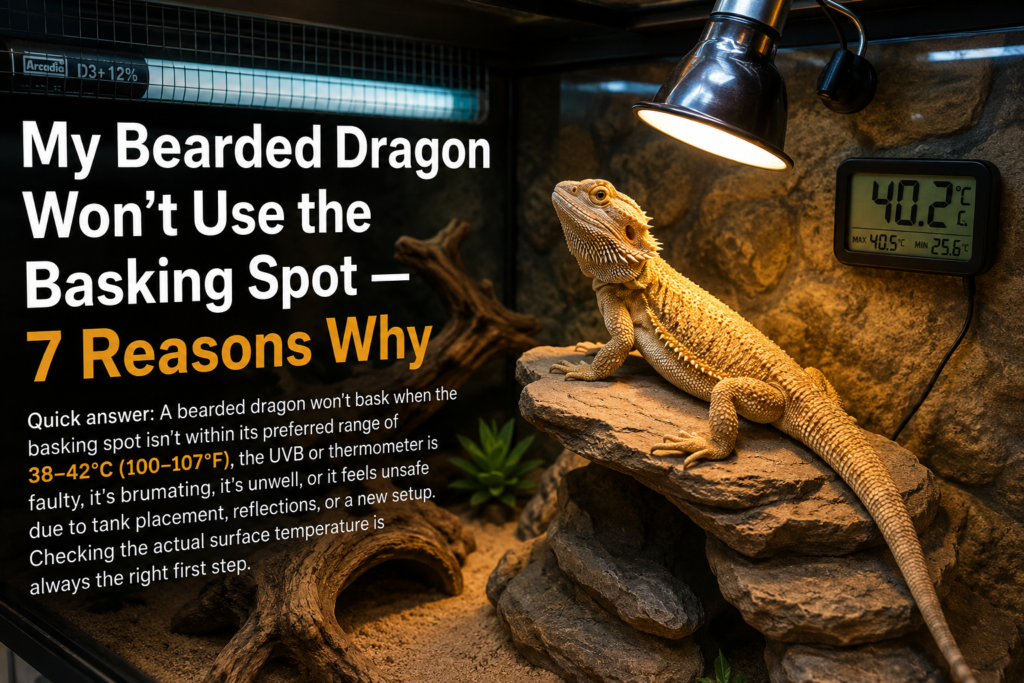
Quick answer: A bearded dragon won’t bask when the basking spot isn’t within its preferred range of 38–42°C (100–107°F), the UVB or thermometer is faulty, it’s brumating, it’s unwell, or it feels unsafe due to tank placement, reflections, or a new setup. Checking the actual surface temperature is always the right first step.
If you’ve noticed your bearded dragon avoiding its basking spot, you’re not imagining it — and it’s rarely “just being difficult.” A healthy beardie is hardwired to bask; it’s how they digest food, build vitamin D3, and stay active. When that instinct switches off, something in the enclosure or the dragon’s health has usually changed. Below are the seven most common reasons a bearded dragon won’t bask, in the order you should check them.
My Bearded Dragon Won’t Use the Basking Spot — 7 Reasons Why
1. The basking spot isn’t actually hot enough
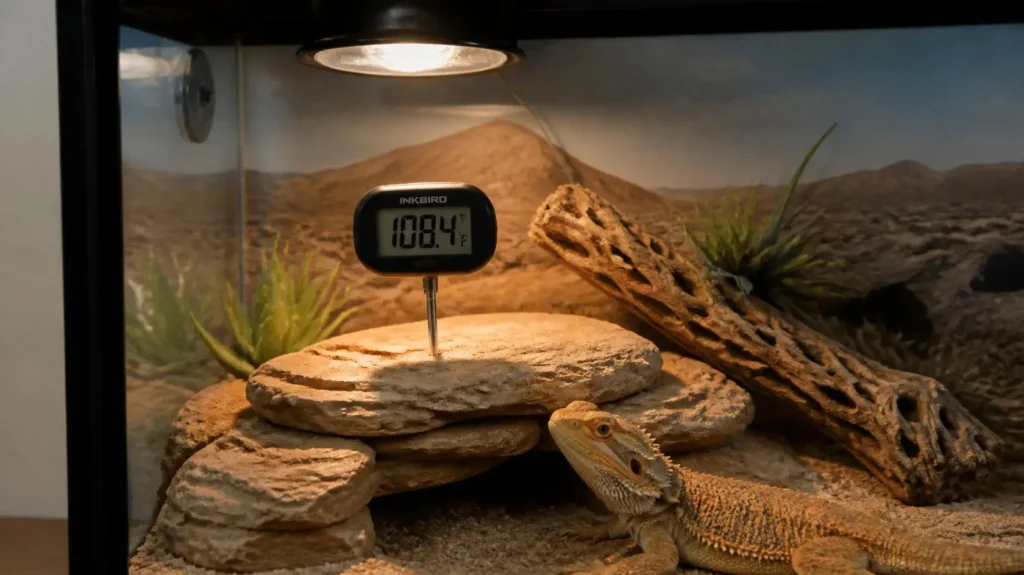
This is the single most common cause. According to the RSPCA’s bearded dragon care sheet, the basking zone should reach 38–42°C (100–107°F), measured at the level where the dragon’s back sits when it’s on the basking platform. A bulb can look bright and still fall short of that temperature if it’s underpowered, too far away, or losing output with age.
How to check and fix it:
- Turn off the room lights and let the basking bulb run for 20–30 minutes to stabilize.
- Point a digital infrared thermometer at the basking surface, not the air above it.
- Compare the reading to the 38–42°C (100–107°F) target range.
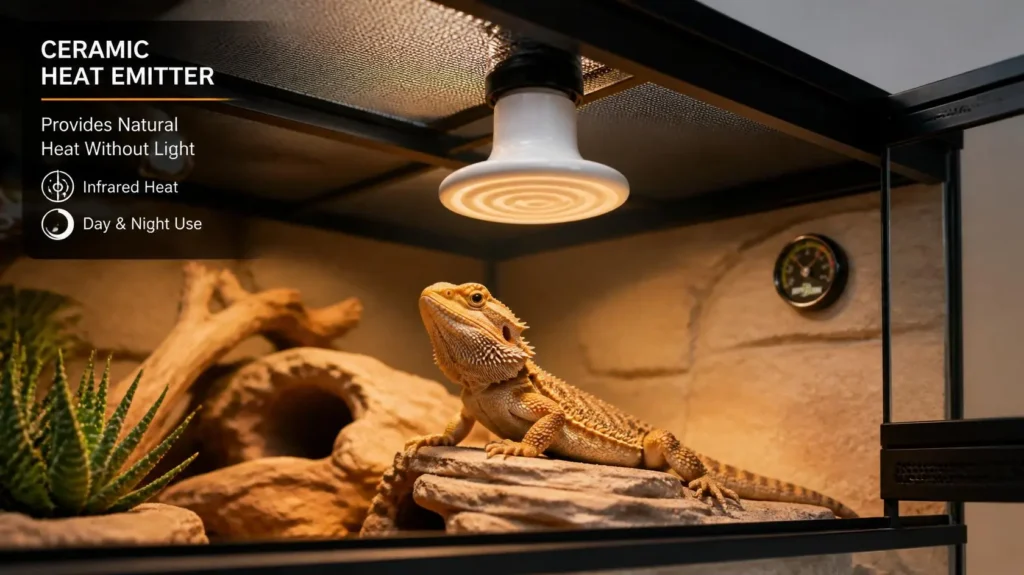
- If it’s too cool, move the bulb 2–3 cm closer, increase the wattage, or switch to a halogen flood bulb designed for basking heat.
- If it’s too hot, raise the bulb or fit a dimming thermostat, since the RSPCA notes a thermostat “must be used with all heat sources.”
- Re-check the temperature 30 minutes after any adjustment.
2. The thermometer is giving you a false reading
Sometimes the basking spot is fine — the thermometer just isn’t reporting it accurately. Stick-on dial thermometers and units placed too far from the actual basking surface are a well-known source of bad readings in reptile keeping. If your numbers look far off from what the bulb wattage and distance would suggest, read our full guide on why your bearded dragon’s basking spot might be reading wrong on your thermometer before you start swapping bulbs.
3. The UVB bulb has stopped working, even though the light still turns on
UVB output degrades long before the visible light does, so a bulb can look completely normal while producing little or no UVB. The RSPCA advises checking UVB output regularly with a UV index meter and replacing the bulb on the manufacturer’s schedule, since a beardie that senses inadequate UVB may bask less or avoid the zone entirely. Most linear UVB tubes need replacing every 6–12 months regardless of whether the light still glows.
4. Your dragon is brumating
Brumation is a natural, hibernation-like slowdown that many adult bearded dragons go through, typically in autumn or winter. A brumating dragon eats less, sleeps more, and may ignore the basking spot for days at a time. This is normal behavior, not a sign that something in the tank is broken — but it’s worth ruling out illness first, since the two can look similar from the outside (see the comparison table below).
5. Illness, pain, or injury is keeping it away from heat
A sick or injured bearded dragon will sometimes avoid basking because moving toward the heat source is physically uncomfortable, or because the illness itself has lowered its activity. Common culprits include metabolic bone disease, respiratory infection, parasites, or impaction. The RSPCA notes that a healthy bearded dragon has clear, bright eyes and becomes brighter in color after basking — a dull, lethargic dragon that also isn’t basking is a stronger signal to book a reptile vet visit than lethargy alone.
6. The enclosure layout doesn’t support a proper thermogradient
Bearded dragons need a clear hot end and cool end to thermoregulate, and the basking platform needs to be positioned so the dragon can actually reach the target temperature. The RSPCA’s minimum recommended vivarium size for one adult is 120 cm long x 60 cm wide x 60 cm high. In an enclosure that’s too small, too cluttered, or has a basking platform set at the wrong height, the dragon may not be able to find a comfortable spot in the heat gradient at all, so it avoids the area entirely rather than overheating.
7. Stress from the tank’s environment or a recent change
Bearded dragons are surprisingly sensitive to their surroundings. Reflective glass that shows a distorted reflection, a tank positioned in a high-traffic area, a recent move, a new tank mate, or even rearranged decor can make a dragon too anxious to sit still in an exposed basking spot. Covering the sides of the enclosure to reduce reflections, or giving a newly rehomed dragon one to two weeks to settle before troubleshooting further, often resolves stress-related avoidance on its own.
Brumation vs. Illness: Quick Comparison
| Sign | Brumation | Illness |
| Appetite | Reduced or absent, but stable weight initially | Reduced, often with noticeable weight loss |
| Activity | Sleepy but responsive when handled | Lethargic, may seem weak or unresponsive |
| Eyes | Clear and bright | Sunken, dull, or partially closed |
| Stool | Infrequent, normal in appearance | Absent, abnormal color, or diarrhea |
| Timing | Usually autumn/winter, in dragons over 12 months old | Can occur at any time of year |
| Vet visit needed? | Not usually, if otherwise healthy | Yes — book a reptile-experienced vet |
FAQ
Why has my bearded dragon suddenly stopped basking? A sudden change usually points to a bulb that’s failed, a thermostat malfunction, or the start of brumation. Check the basking surface temperature first with a digital infrared thermometer, since a burnt-out or dying bulb is the most common sudden cause.
Is it normal for a bearded dragon to skip basking for a few days? Occasional short breaks can be normal, especially during shedding or brumation in adult dragons. However, if your dragon also stops eating, looks dull-eyed, or avoids basking for more than 3–4 days with no obvious seasonal trigger, a vet check is worth arranging.
What temperature should my bearded dragon’s basking spot be? The RSPCA recommends a basking zone of 38–42°C (100–107°F), measured at the level where the dragon rests, with the cooler end of the enclosure kept at 22–26°C.
Can a bearded dragon overheat and avoid the basking spot because of that? Yes. If the basking surface runs hotter than the 38–42°C range, a dragon will often avoid it entirely rather than risk overheating, which can look identical to a “won’t bask” problem caused by a bulb that’s too weak.
Do baby bearded dragons bask differently than adults? Young bearded dragons generally bask more frequently and for shorter bursts than adults, since they’re growing faster and regulating body temperature more often throughout the day. A juvenile that isn’t basking at all still warrants the same temperature and health checks as an adult.

Haseeb Wattoo is the founder and author of Beardie Dragon Pro. He is passionate about bearded dragon care and shares practical, research-based guides on nutrition, habitat setup, health, behavior, and husbandry. His mission is to help reptile owners provide the best care for their pets through accurate, easy-to-understand, and trustworthy information. Haseeb aims to educate both beginners and experienced keepers, promoting responsible pet ownership and healthier, happier bearded dragons.