Quick Answer
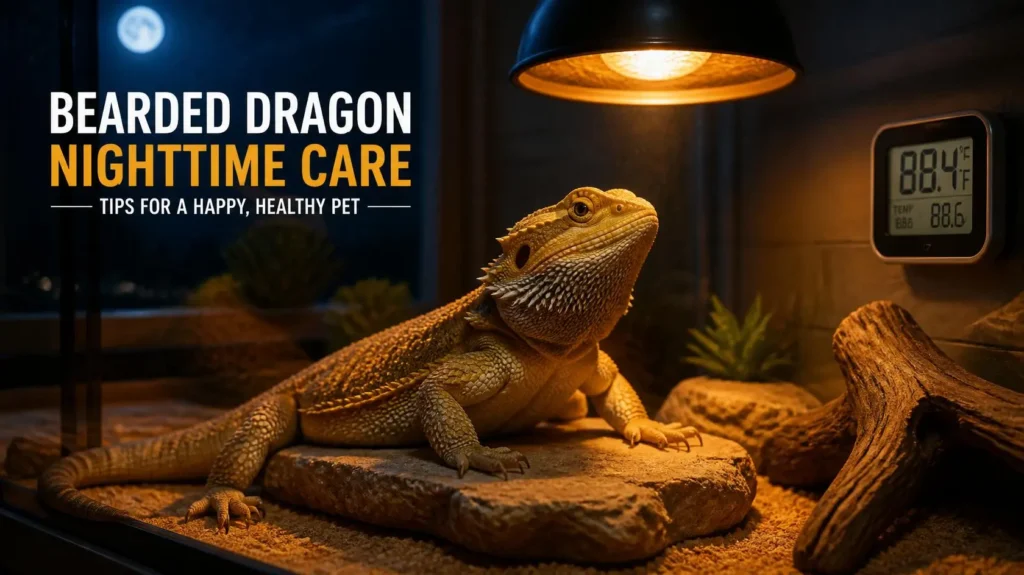
For nighttime heat, a ceramic heat emitter (CHE) is the safer and more effective choice for bearded dragons. It warms the air inside the enclosure the way an overhead basking light does, without producing light that disrupts sleep. A heat mat (under-tank heater) is not recommended as a primary or supplemental heat source for bearded dragons, because it heats a small patch of surface rather than the air, and bearded dragons have very few heat-sensing nerves on their belly — so they can suffer thermal burns before they even try to move away.
In most homes, though, neither is required. Bearded dragons tolerate a nighttime drop to around 65–70°F (18–21°C) just fine. You only need supplemental heat if your room regularly falls below that.
Why Nighttime Heat Is Different From Daytime Heat
Bearded dragons are ectotherms — their body temperature depends entirely on their surroundings. During the day, they need a strong basking spot (100–110°F) created by an overhead bulb, plus a cooler side of the tank to retreat to. That’s a big, deliberate temperature gradient.
At night, the goal is completely different. The dragon is asleep, not thermoregulating by moving around, so it doesn’t need a hot basking zone. It needs the whole enclosure to stay within a safe, stable ambient temperature range while staying dark. This is exactly where people get tempted to reach for a heat mat, because it seems like a small, low-key way to add background warmth. In practice, that instinct causes more harm than good, which is the whole reason this comparison matters.
What Is a Ceramic Heat Emitter?
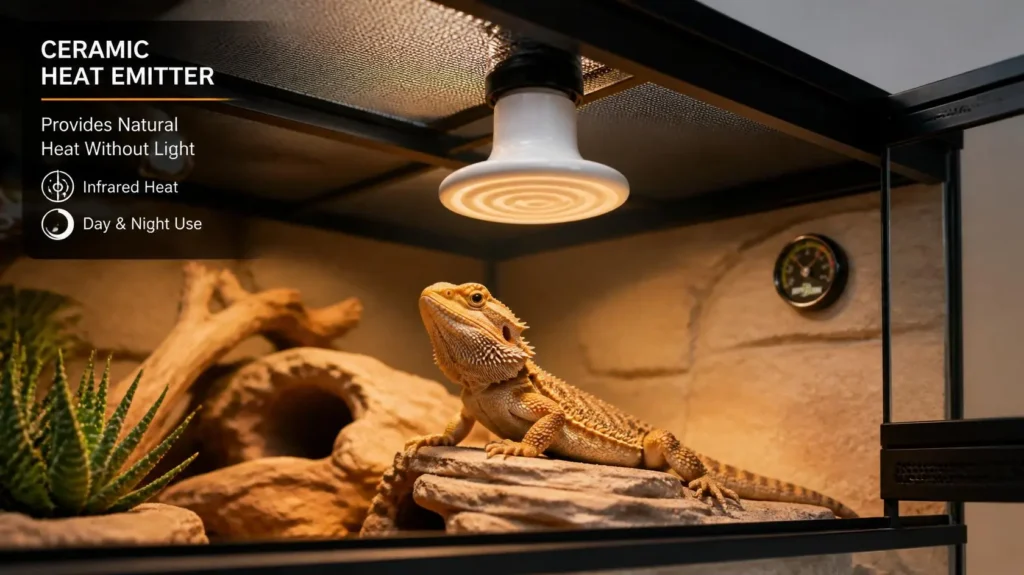
A ceramic heat emitter (CHE) is a bulb-shaped ceramic element that screws into a standard ceramic light socket, just like a basking bulb — except it produces infrared heat with zero visible light. That’s the key feature: it can run all night without disturbing a bearded dragon’s sleep cycle the way a red, blue, or “moonlight” bulb would.
Because it radiates heat from above, a CHE warms the air in the enclosure the same way the sun and a basking bulb do. It raises the overall ambient temperature rather than heating one small surface.
How it’s used for nighttime heat:
- Mounted in a dome or clamp fixture above the enclosure, in a ceramic-rated socket
- Connected to a thermostat (ideally a pulse-proportional or on/off thermostat) so it only activates when needed
- Sized in watts based on enclosure volume and how cold the room actually gets
What Is a Heat Mat?
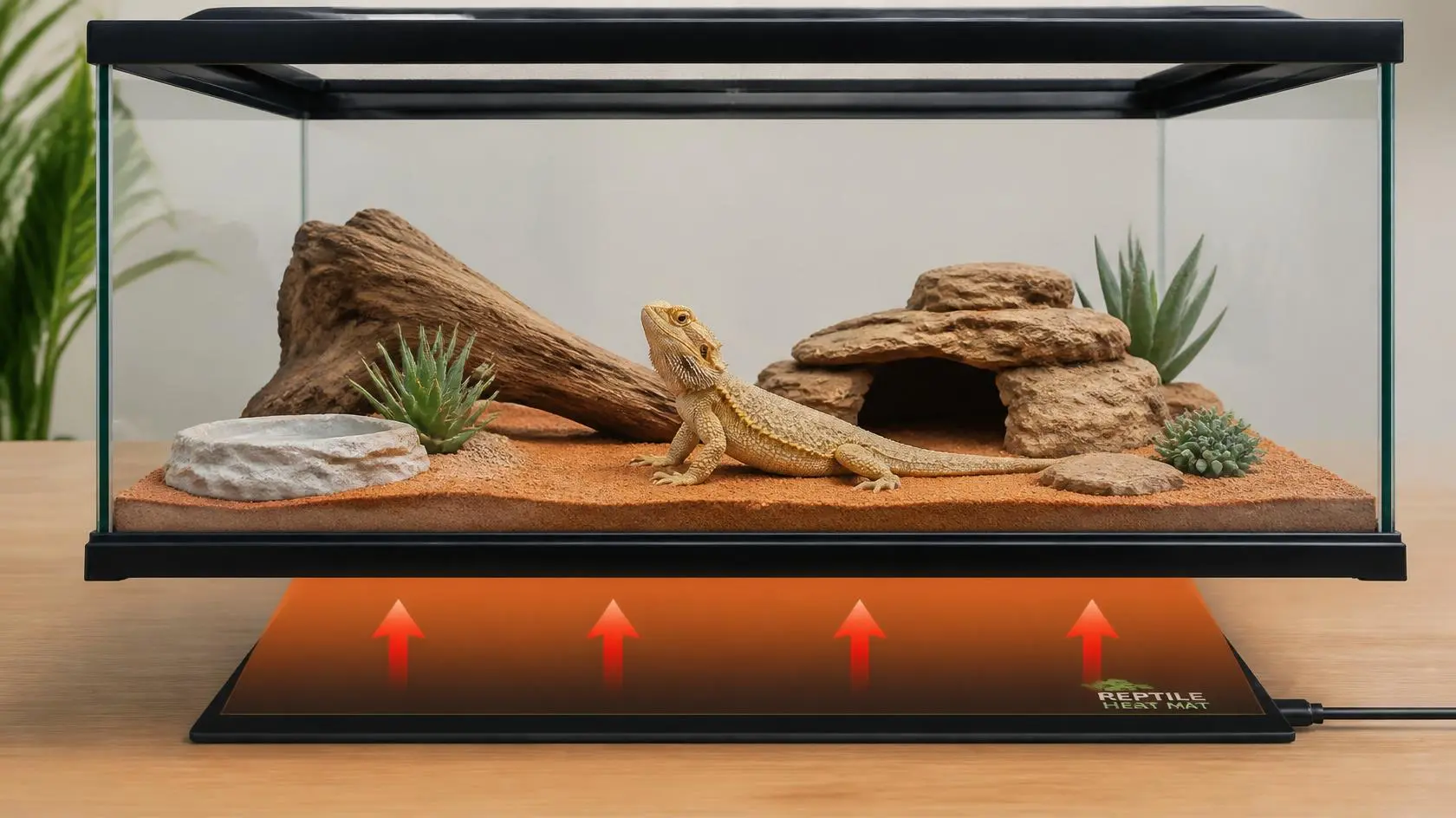
A heat mat — also called an under-tank heater (UTH) — is a thin adhesive heating pad placed on the outside bottom or side of a glass or PVC enclosure. It’s commonly used for snakes and some geckos that thermoregulate through belly contact with warm substrate.
For bearded dragons, this is a mismatch. Bearded dragons are heliothermic — they evolved basking on sun-warmed rocks in open Australian scrubland, sensing and regulating heat primarily through their backs and heads, not their bellies. A device built around belly-contact heating works against their natural biology instead of with it.
Ceramic Heat Emitter vs. Heat Mat: Comparison Table
| Feature | Ceramic Heat Emitter (CHE) | Heat Mat / UTH |
|---|---|---|
| Heats | Ambient air, whole enclosure | One localized surface patch |
| Matches natural behavior | Yes — heat from above, like the sun | No — bearded dragons sense heat poorly from below |
| Light produced | None (safe for sleep) | None |
| Burn risk | Low, if placed with a screen guard and thermostat | Higher — dragons often don’t react before overheating occurs |
| Effective for raising ambient temp | Yes | Generally no, especially in larger enclosures |
| Requires a thermostat | Strongly recommended | Essential, non-negotiable |
| Typical cost | $10–$25 for the bulb, plus fixture | $10–$20 |
| Vet/keeper consensus for bearded dragons | Widely recommended nighttime option | Widely discouraged |
| Best used for | Bearded dragons, other basking reptiles | Snakes and species that thermoregulate through belly contact |
Why Heat Mats Are Risky for Bearded Dragons
This isn’t a minor preference — it’s one of the most consistent warnings across reptile-keeping communities and care guides:
1. Bearded dragons have limited nerve sensitivity on their underside. Compared to their backs, their bellies are far less able to detect building heat. That means a dragon can stay pressed against a hot surface well past the point of injury before it feels a need to move.
2. Mats heat a small, fixed area — not the room. Even a well-functioning mat only warms whatever is directly touching it (and the air immediately around it). It doesn’t raise the overall ambient temperature of a 40-gallon-plus enclosure the way an overhead heat source can, so it fails at the actual job of nighttime heating.
3. Faulty units heat up fast, with little warning. If a mat’s internal element fails or a thermostat probe isn’t positioned correctly, the surface can spike in temperature quickly — faster than a dragon can react.
4. They make it easy to create “hot spots” instead of a gradient. A proper enclosure needs a warm side and cool side. A mat under one section of glass or PVC just creates an uneven hot patch, not a usable thermal gradient.
5. Even “safe” installation still adds unnecessary risk for no real benefit. Some keepers do use mats successfully with a strict thermostat, mounted outside the enclosure, covering less than half the floor space, with airflow underneath. Even done carefully, the mat isn’t accomplishing anything a properly sized CHE can’t do more reliably — so most experienced keepers see the risk-to-benefit ratio as unfavorable for bearded dragons specifically.

How to Set Up a Ceramic Heat Emitter Correctly
A CHE is safer than a heat mat, but it isn’t automatically safe — the element itself gets extremely hot, and it still needs to be installed with care.
- Use a ceramic-rated socket only. Standard plastic light sockets can melt or catch fire under a CHE’s heat output. The fixture must be explicitly rated for ceramic heat emitters.
- Always pair it with a thermostat. A CHE run without any temperature control can overheat the enclosure overnight. A pulse-proportional or simple on/off thermostat, set to your target low temperature, keeps it from running constantly.
- Install a wire mesh screen guard between the enclosure and the fixture so your dragon can never climb up and make direct contact with the hot element.
- Choose wattage based on your specific setup, not a generic recommendation — enclosure size, room temperature, and how enclosed the tank is all affect how many watts you actually need. Start lower and adjust based on a thermometer reading, not a guess.
- Position it so it only affects ambient air, not a single basking spot — nighttime heat should be gentle and enclosure-wide, not a second basking zone.
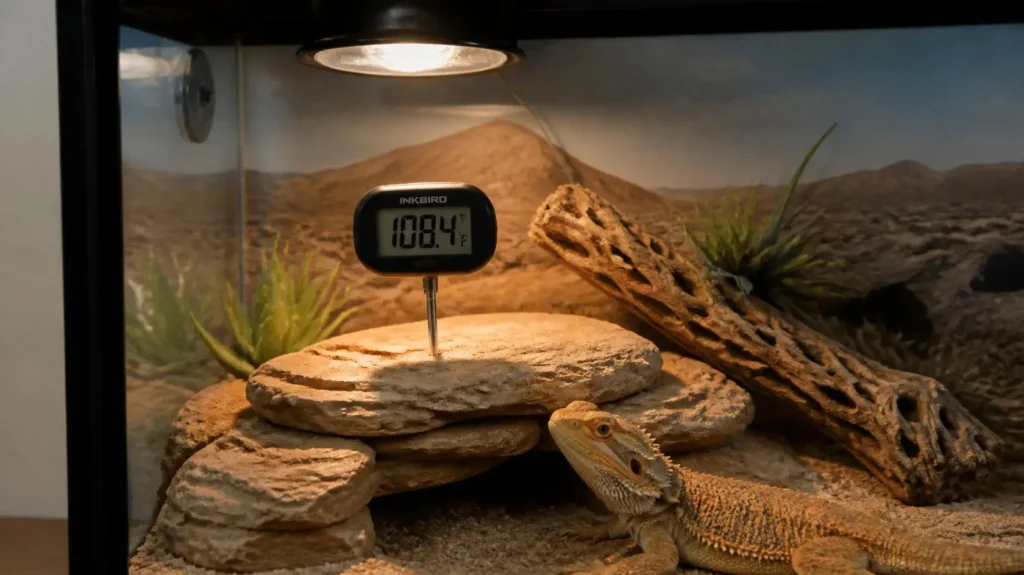
- Use a digital thermometer with a probe, not a stick-on dial gauge, to confirm the actual overnight low inside the enclosure.
Do You Even Need Nighttime Heat?
This is the step most keepers skip, and it’s the most important one. Bearded dragons don’t need constant warmth around the clock — a modest nighttime dip is natural and expected, mirroring the temperature swing they’d experience in the wild.
General nighttime guidelines:
- Adults: comfortably tolerate lows around 65–70°F (18–21°C)
- Juveniles/hatchlings: benefit from a slightly warmer range, closer to 75–80°F (24–27°C)
- Below roughly 60–65°F: this is generally the point where supplemental heat becomes worth considering
If your home’s overnight temperature naturally stays above the low end of these ranges, you likely don’t need any additional nighttime heat source at all — mat or CHE. Adding heat unnecessarily just adds cost, equipment, and risk for no benefit. Check with a thermometer before buying anything.
Common Mistakes Keepers Make
- Using a colored “night bulb” for heat. Red, blue, and purple bulbs still emit visible light that bearded dragons can perceive, disrupting their sleep cycle even though the color looks dim to humans.
- Assuming a heat mat is “just backup” and therefore lower risk. A backup device still needs the same safety standards as a primary one.
- Skipping the thermostat to save money. This is the single most common cause of both overheating injuries and house fires involving reptile heating equipment.
- Relying on a stick-on analog gauge. These are notoriously inaccurate. A digital thermometer with a probe gives a real reading of what’s happening at dragon level, not tank-wall level.
- Sizing wattage off a forum recommendation instead of your actual room. The “right” wattage depends on your specific enclosure and ambient room temperature — not a one-size-fits-all number.
- Covering or insulating a heat mat’s housing. Placing an enclosure on carpet or foam over a mat traps heat and can push surface temperatures far higher than intended.
Decision Checklist
Use this quick checklist before choosing (or skipping) a nighttime heat source:
- I’ve measured my actual overnight enclosure temperature with a digital thermometer
- The reading regularly drops below 65°F
- I’m choosing a ceramic heat emitter, not a heat mat, as my heat source
- My CHE fixture uses a ceramic-rated socket
- I have a thermostat to regulate it
- I have a wire mesh guard preventing direct contact with the fixture
- I’m avoiding colored “night” bulbs entirely
If you checked the first two boxes and the rest are still open, that’s your setup roadmap.
Signs of a Heating Problem — When to Call a Vet
Reptile skin injuries are not always obvious right away, and improper nighttime heat can contribute to both burns and dangerous cold snaps. Contact an exotics-experienced veterinarian promptly if you notice:
- Discoloration, blistering, or an open wound anywhere on the body
- Unusual stiffness, lethargy, or reluctance to move
- Refusal to eat combined with a cold enclosure reading
- A strong or unusual odor near a suspected injury site
- Any sign your dragon was in prolonged contact with an unregulated heat source
This article is educational and does not replace a diagnosis. If you suspect a burn, thermal Stress, or illness, an exotics veterinarian is the right next step — don’t try to treat it at home.
FAQs
Can I use a heat mat and a ceramic heat emitter together?
There’s rarely a reason to. If your CHE is properly sized and thermostatted, it already handles ambient nighttime heat for the whole enclosure — adding a mat only adds burn risk without solving a real problem.
Will a ceramic heat emitter keep my bearded dragon warm enough on its own?
Yes, when it’s correctly sized for your enclosure and room temperature, and controlled by a thermostat, a CHE is capable of maintaining a safe ambient temperature through the night.
Is it true bearded dragons can’t feel heat on their bellies?
Bearded dragon bellies have comparatively few heat-sensing nerve endings versus their backs, which is the widely cited reason belly-contact heating is considered risky. Some keepers note the underlying research is thinner than the popular explanation suggests — but the practical outcome (dragons not reliably reacting in time to heat mat burns) is well documented regardless of the exact mechanism.
What wattage ceramic heat emitter do I need?
It depends on your enclosure size, how enclosed it is, and your room’s typical overnight low. There’s no single universal number — start with a modest wattage, monitor with a digital thermometer, and adjust from there.
Do I need a special thermostat for a ceramic heat emitter?
A basic on/off thermostat works for many setups. A pulse-proportional thermostat offers steadier, more precise control and is generally preferred by experienced keepers, especially for larger or drafty enclosures.
Is a heat mat ever appropriate for a bearded dragon enclosure?
It’s not recommended as a heat source for the dragon itself. It’s a better fit for species that regulate temperature through belly contact, like many snakes.
Can I use a regular red or purple night bulb instead of a CHE?
It’s not ideal. Even “night-specific” colored bulbs emit visible light that bearded dragons can perceive, which can interfere with normal sleep patterns.
How cold is too cold for a bearded dragon at night?
As a general guideline, ambient temperatures dropping much below roughly 60–65°F are when supplemental heat becomes worth considering for adults; hatchlings and juveniles need a warmer floor.
Does a ceramic heat emitter produce any light at all?
No — that’s its defining feature. It produces infrared heat with no visible light output, unlike a basking bulb or colored night bulb.
My bearded dragon likes to sit on the warm side of the tank at night — is that a bad sign?
Not necessarily. Seeking out the warmest available spot is normal thermoregulatory behavior. It only becomes a concern if the “warm spot” is a heat mat or another surface they’re in direct, prolonged contact with.
Can a ceramic heat emitter cause a fire?
It can, if used improperly — specifically with a non-ceramic-rated socket, without a thermostat, or too close to flammable material. Following manufacturer specs and using proper ceramic fixtures greatly reduces this risk.
Key Takeaways
- Ceramic heat emitters are the recommended nighttime heat source for bearded dragons — they warm the air, produce no disruptive light, and match natural heliothermic behavior.
- Heat mats are not recommended for bearded dragons, primarily because of poor belly heat-sensing and localized (rather than ambient) heating.
- Many keepers don’t need supplemental nighttime heat at all — check your actual overnight temperature before buying equipment.
- A thermostat is non-negotiable for any nighttime heat source, CHE included.
- Never use colored “night” bulbs as a substitute — they still emit visible light.

Haseeb Wattoo is the founder and author of Beardie Dragon Pro. He is passionate about bearded dragon care and shares practical, research-based guides on nutrition, habitat setup, health, behavior, and husbandry. His mission is to help reptile owners provide the best care for their pets through accurate, easy-to-understand, and trustworthy information. Haseeb aims to educate both beginners and experienced keepers, promoting responsible pet ownership and healthier, happier bearded dragons.