If you check your bearded dragon’s enclosure at 2 a.m. and the thermometer reads far lower than it did at noon — even though the heat lamp never turned off — you’re not imagining it, and you’re not alone. This is one of the most common husbandry questions new and experienced keepers run into.
Quick Answer
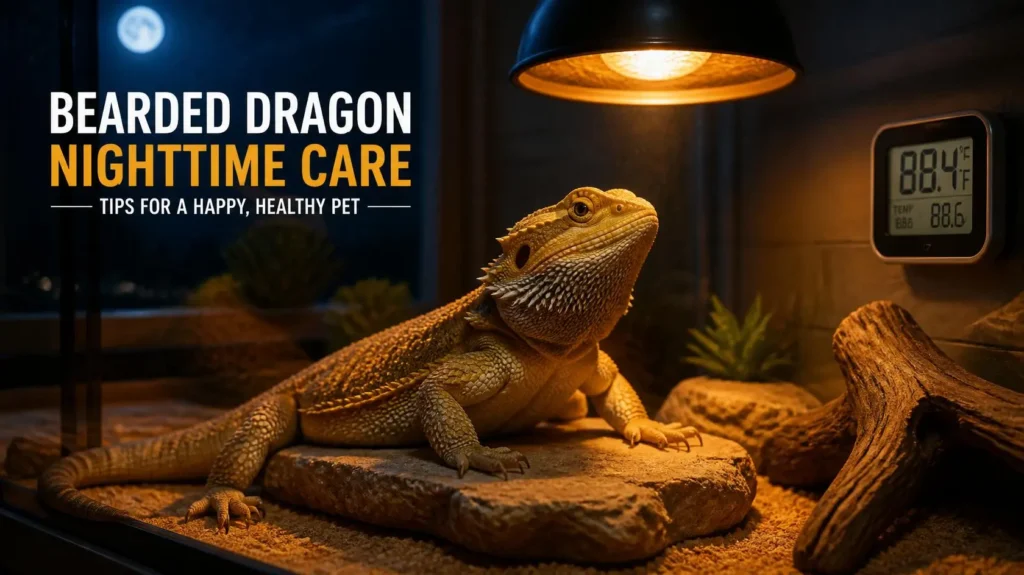
Your tank cools at night because a standard heat lamp (basking bulb) heats a small spot, not the whole enclosure — and once room temperature drops after dark, that single point of heat can’t fight the surrounding cold air, drafts, and heat escaping through a screen top. In most cases, this is actually by design: bearded dragons should not have bright light at night, and a mild, controlled temperature drop is normal. The problem is only serious when temperatures fall below the safe overnight range (roughly 65–75°F / 18–24°C, never below 60°F / 15.5°C), or when the drop is sudden and extreme.
Is a Nighttime Temperature Drop Actually Normal?
Yes — within limits. In their native arid regions of central Australia, bearded dragons experience a natural day-to-night temperature swing. Daytime basking spots can exceed 95–110°F (35–43°C), while nighttime lows drop noticeably, sometimes into the 60s°F (mid-teens °C). A moderate overnight cooling is a biological cue, not a flaw in your setup.
The distinction that matters is between:
- A normal, gradual drop into the mid-to-upper 60s or low 70s°F (roughly 18–24°C) — generally fine for a healthy adult.
- An excessive, sudden, or uncontrolled drop below 65°F (18°C), especially if it happens repeatedly — this stresses the immune system, slows digestion, and can trigger unwanted brumation-like behavior in dragons that aren’t ready for it (including juveniles, who should not brumate).
If your heat lamp is your only heat source and it’s the middle of winter, a drop of 15–20°F between day and night readings is common and expected. A drop into the 50s°F, or a tank that feels cold to the touch, is not.
The 7 Real Reasons Your Tank Loses Heat at Night
1. A Heat Lamp Only Warms a Spot, Not the Whole Enclosure
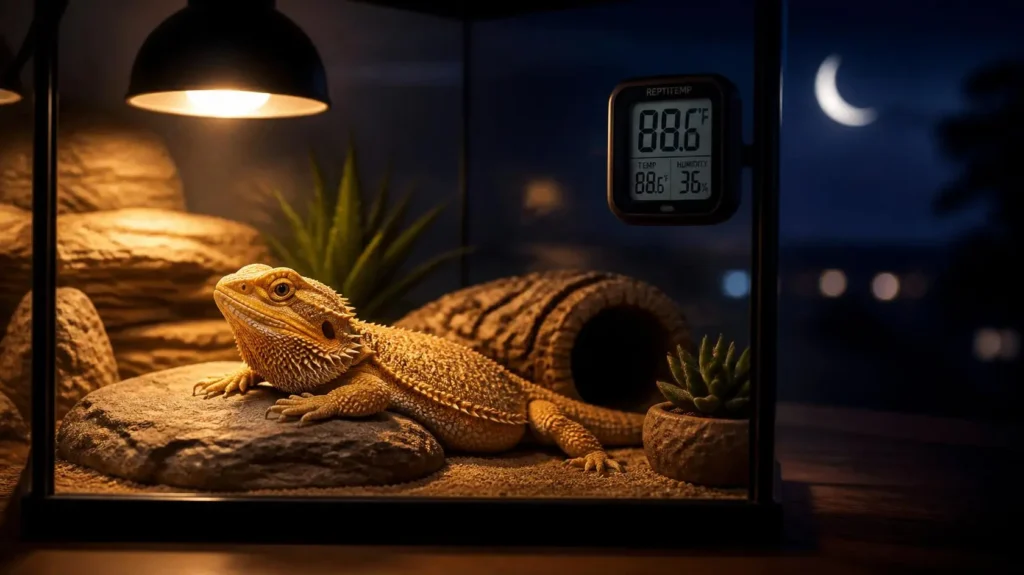
Basking bulbs are directional. They create a hot zone directly beneath them but do very little to raise the ambient (overall air) temperature of a large tank, especially once outside air cools the glass and mesh at night.
2. Room Temperature Drops After Dark
Most homes cool by several degrees overnight, especially if the thermostat is lowered for sleep. Your enclosure doesn’t exist in isolation — it’s constantly exchanging heat with the room around it.
3. Screen/Mesh Tops Leak Heat Rapidly
Ventilated lids are important for airflow, but they’re also the single biggest source of heat loss in most setups. Heat rises and escapes straight through open mesh, which is why enclosures with more open-top area cool faster than tanks with solid or partially covered lids.
4. Drafts From Windows, Vents, or Doorways
Even a small draft near the enclosure can pull warm air out and pull cold air in, especially if the tank sits near an exterior wall, window, or AC/heating vent.
5. Insufficient Wattage or an Aging Bulb
Bulbs lose output as they age, and a bulb sized for a smaller tank won’t sufficiently heat a larger one. If your bulb hasn’t been replaced in 6–12 months, reduced output could be part of the problem.
6. No Secondary Heat Source for Nighttime
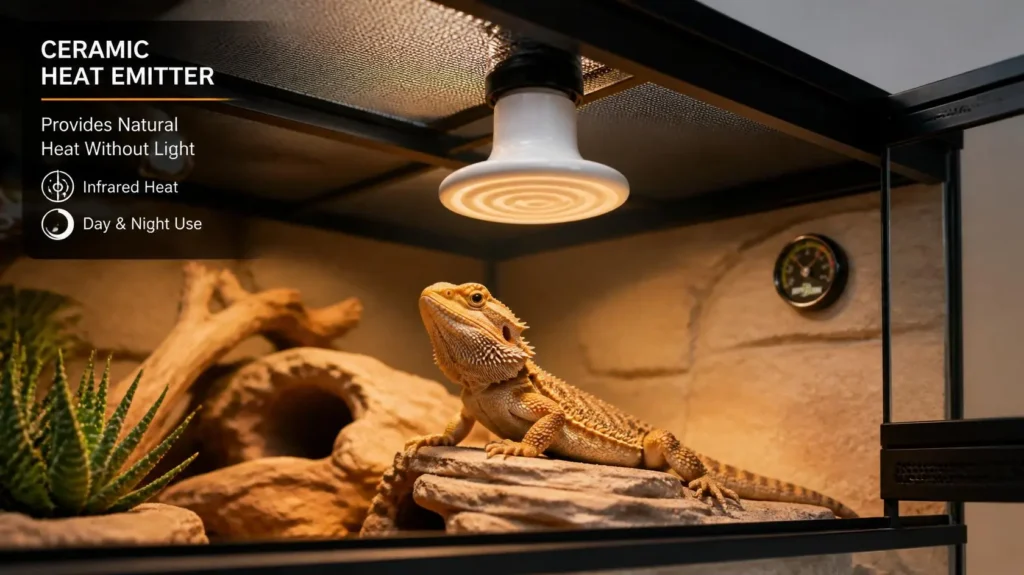
This is the most overlooked cause. Bearded dragons should not have a bright light on at night — it disrupts their sleep cycle. That means many keepers turn the basking light off after dark, leaving nothing to maintain ambient warmth. Without a non-light heat source (like a ceramic heat emitter), the tank has no way to stay warm once the lamp goes dark.
7. Uncalibrated or Missing Thermostat
Without a thermostat, you have no way of knowing the actual temperature your bulb or heater is producing — you’re guessing. A miscalibrated thermostat can also be silently under- or over-heating the enclosure.
Heat Lamp vs. Ceramic Heat Emitter vs. Deep Heat Projector vs. Heat Mat
| Heat Source | Produces Light? | Best Use | Raises Ambient Temp? | Notes |
|---|---|---|---|---|
| Basking Heat Lamp (halogen/incandescent) | Yes | Daytime basking spot | Minimal | Should generally be turned off at night to preserve normal sleep cycle |
| Ceramic Heat Emitter (CHE) | No | 24-hour ambient/nighttime heat | Moderate–High | Ideal night-time solution; must be paired with a thermostat |
| Deep Heat Projector (DHP) | No (infrared only) | Daytime + can supplement basking heat | High | Mimics natural solar radiant heat more closely than standard bulbs |
| Heat Mat/Under-Tank Heater | No | Belly heat, supplemental warmth | Low–Moderate | Not a substitute for overhead heat; best used with a thermostat and never as the sole heat source |
Takeaway: If your only heat source is a basking bulb, you may have no way to safely maintain warmth once you (correctly) turn the light off at night. A ceramic heat emitter on its own thermostat is the standard solution.
Safe Temperature Ranges by Time of Day
| Zone | Daytime Target | Nighttime Target |
|---|---|---|
| Basking spot | 95–110°F (35–43°C) — adjust for age; juveniles run slightly warmer | Light off; no basking spot needed |
| Warm side (ambient) | 90–100°F (32–38°C) | 70–75°F (21–24°C) |
| Cool side (ambient) | 80–90°F (27–32°C) | 65–75°F (18–24°C) |
| Absolute minimum | — | Not below 60°F (15.5°C) |
These are general husbandry guidelines. Always cross-check with a current care sheet or reptile veterinarian, since recommendations can vary slightly by dragon age, health, and region.
Step-by-Step: How to Diagnose Your Setup Tonight
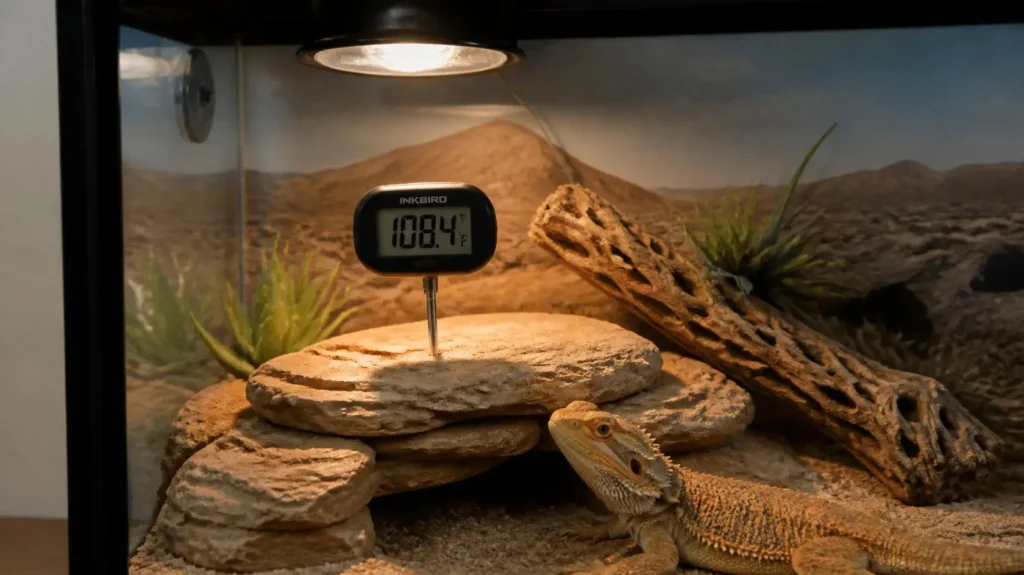
- Use a digital probe thermometer, not stick-on strips. Stick-on strips are notoriously inaccurate. Place probes at the basking spot, mid-tank ambient level, and the cool side.
- Check the reading at three points: late afternoon, right after lights-out, and again 4–6 hours later. This shows you the actual rate of decline, not just a single snapshot.
- Feel for drafts. Hold a hand (or a lit incense stick/tissue, away from the heat source) near the lid and any vents to check for airflow.
- Inspect the lid coverage. Estimate what percentage of the top is open mesh versus solid.
- Check bulb age and wattage. If it’s been more than 6–12 months, consider replacing it, even if it still lights up.
- Confirm you have a working thermostat. If your heat source plugs directly into the wall with no thermostat, this is very likely your core issue.
- Note the room’s overnight low. A quick check of your thermostat or a room thermometer tells you how much the environment itself is working against you.
How to Fix It: Practical Solutions
Add a dedicated nighttime heat source. A ceramic heat emitter (CHE) on its own thermostat is the most common fix — it produces heat without light, so it won’t disturb sleep, and it can run 24/7 if needed.
Use a thermostat on every heat source. This isn’t optional for safety. A thermostat prevents both overheating (a fire and burn risk) and the silent under-heating that causes nighttime drops.
Reduce heat loss from the lid. Covering a portion of the screen top (leaving adequate ventilation) can significantly slow heat loss without compromising airflow.
Reposition the enclosure. Move it away from exterior walls, windows, and HVAC vents where possible.
Upgrade bulb wattage appropriately for tank size, following the bulb manufacturer’s enclosure-size guidance rather than guessing.
Consider a low-wattage habitat-safe space heater for the room in very cold climates, so the whole environment — not just the enclosure — stays within a reasonable range overnight.
Insulate around (not inside) the enclosure using materials safe for the tank exterior, such as foam board behind glass panels, to reduce heat loss through the walls.
Common Mistakes Keepers Make
- Leaving the basking light on 24/7 to “keep it warm” — this disrupts the dragon’s natural light cycle and sleep, and still may not solve ambient heat loss.
- Relying on stick-on thermometer strips, which can be inaccurate by several degrees.
- Using a heat mat as the only heat source, when it’s designed as supplemental belly heat, not primary ambient heat.
- No thermostat at all, running heat sources directly from the outlet.
- Assuming bigger wattage always equals better heating without checking actual measured temperatures.
- Placing the tank in a “convenient” spot near a window or vent without checking for drafts.
When a Cold Tank Becomes an Emergency
A cool night is usually harmless. Watch for these signs that indicate the temperature drop has become a genuine problem requiring prompt veterinary attention:
- Lethargy that doesn’t improve once the enclosure warms back up
- Refusal to eat for several consecutive days combined with cold ambient temps
- Darkened or blackened beard/limbs (can indicate stress or illness, not just cold)
- Sunken eyes, weakness, or an unresponsive dragon
- Unintended brumation behavior in a juvenile (under 12–18 months), which should not occur
This article is for general husbandry education and is not a substitute for veterinary care. If your bearded dragon shows any of the signs above, or you’re unsure whether what you’re seeing is illness versus normal seasonal behavior, contact an exotics/reptile veterinarian promptly.
Prevention Checklist
- Digital probe thermometers placed in basking, ambient, and cool zones
- Thermostat installed on every heat-emitting device
- Non-light heat source (CHE or similar) available for overnight use
- Bulbs replaced on a 6–12 month schedule
- Lid ventilation balanced — airflow maintained, excess heat loss minimized
- Enclosure positioned away from drafts, windows, and vents
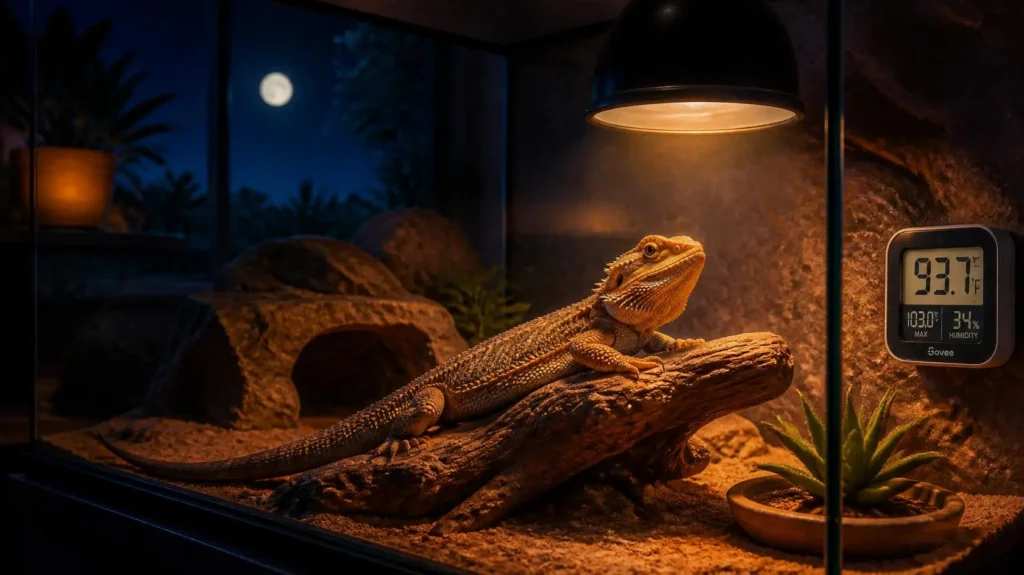
- Nighttime and daytime temps logged for at least one full week to confirm stability
- Backup heat plan in place for power outages or extreme cold snaps
Decision Tree: What Should You Do Right Now?
- Is your nighttime ambient temperature between 65–75°F (18–24°C)? → Yes: This is likely a normal, healthy drop. No action needed beyond routine monitoring. → No, it’s below 65°F (18°C): Continue to step 2.
- Do you have a non-light heat source (CHE, DHP) running at night? → No: This is your most likely fix — add one on a dedicated thermostat. → Yes: Continue to step 3.
- Is the heat source on a thermostat, and is the thermostat calibrated correctly? → No thermostat / uncalibrated: Install or recalibrate — this is a safety priority, not just a comfort issue. → Yes, and temps are still low: Continue to step 4.
- Check for drafts, excessive open mesh, room temperature, and bulb wattage/age. → Address whichever factor(s) apply, then re-measure over 2–3 nights.
- Still not resolved, or dragon shows signs of illness? → Consult a reptile veterinarian.
Expert Tips
- Measure, don’t guess. A $15–20 digital probe thermometer with min/max memory will tell you more in one night than weeks of assumptions.
- Pair every heater with its own thermostat, even if the heater has a built-in dial — built-in dials are rarely precise enough on their own.
- A gradual nighttime cool-down is a feature, not a bug, as long as it stays within the safe range — it can support a healthy sleep-wake rhythm.
- Log temperatures for a full week, not just one night. Weather, HVAC cycles, and drafts vary day to day.
- Don’t chase “warmer is always better.” Overheating a nighttime enclosure carries its own risks, including disrupted sleep and burns from poorly regulated heat sources.
FAQs
Is it bad if my bearded dragon’s tank drops to 65°F at night?
Generally no — 65–75°F (18–24°C) is within the commonly recommended safe overnight range for most healthy adult bearded dragons. Consistently going below 60°F (15.5°C) is a concern.
Should I leave the heat lamp on all night?
Most husbandry guidance recommends turning bright basking lights off at night to preserve a normal light/dark cycle. Use a non-light heat source (like a ceramic heat emitter) instead if nighttime heat is needed.
What’s the difference between a heat lamp and a ceramic heat emitter?
A heat lamp produces both light and heat and is meant for daytime basking. A ceramic heat emitter (CHE) produces heat only, with no light, making it suitable for overnight use without disturbing sleep.
Why is my tank still cold even with a high-wattage bulb?
Wattage alone doesn’t guarantee results — tank size, ventilation, room temperature, and drafts all affect how much of that heat actually stays in the enclosure. Measured temperature matters more than the number on the bulb box.
Do I need a thermostat if I already have a thermometer?
Yes. A thermometer only tells you the current temperature; a thermostat actively regulates the heat source to maintain a target temperature and prevents both dangerous overheating and unnoticed under-heating.
Can a cold enclosure cause brumation?
Extended cool ambient temperatures combined with shorter daylight hours can trigger brumation-like behavior, especially in adults. This should not happen in juveniles under roughly 12–18 months old, and unexpected brumation-like symptoms warrant a veterinary check to rule out illness.
Is a heat mat enough to keep the tank warm at night?
On its own, typically not. Heat mats are usually intended as supplemental belly heat rather than a primary ambient heat source, and should be used with a thermostat.
How much does temperature typically drop overnight in a healthy setup?
A drop of roughly 10–20°F (about 6–11°C) from daytime basking/ambient highs to nighttime lows is common and generally considered acceptable, provided the lower end stays within the safe range.
Why does the screen top matter so much for heat retention?
Mesh and screen lids allow rising warm air to escape freely, making them the largest single source of heat loss in most enclosures — far more significant than most keepers expect.
What’s the fastest way to check if my current setup is actually a problem?
Place a digital probe thermometer at ambient height and record the reading right at lights-out and again 5–6 hours later. If it stays within 65–75°F (18–24°C), your setup is likely fine as-is.
Can cold temperatures affect digestion?
Yes. Bearded dragons are ectothermic, meaning their digestion depends heavily on external temperature. Prolonged cold, especially after a recent meal, can slow or impair digestion.
Key Takeaways
- A modest, controlled overnight temperature drop (65–75°F / 18–24°C) is normal and often beneficial.
- Standard basking heat lamps warm a spot, not the whole enclosure — they are not designed to maintain ambient heat overnight.
- The most common fix is adding a non-light heat source, like a ceramic heat emitter, on its own thermostat.
- Screen/mesh lids, drafts, room temperature, and bulb age all meaningfully affect how much heat your tank retains after dark.
- A thermostat isn’t optional — it’s the difference between guessing and knowing your enclosure is safe.
- Persistent readings below 60°F (15.5°C), or any signs of lethargy/illness, warrant a veterinary consultation.
Conclusion
A nighttime temperature dip isn’t automatically a red flag — it’s often exactly what a healthy bearded dragon’s internal clock expects. The real question isn’t “why is it dropping,” but “how far is it dropping, and do I have the right tools to control it.” In almost every case where the drop is excessive, the root cause traces back to one of three things: no dedicated nighttime heat source, no thermostat, or unchecked heat loss through the lid and drafts. Fix those three, and your enclosure will hold a safe, stable range through the night — no matter what the thermometer said this morning.
This article provides general husbandry information and is not a substitute for individualized veterinary advice. If you have concerns about your bearded dragon’s health or behavior, consult a licensed reptile/exotics veterinarian.

Haseeb Wattoo is the founder and author of Beardie Dragon Pro. He is passionate about bearded dragon care and shares practical, research-based guides on nutrition, habitat setup, health, behavior, and husbandry. His mission is to help reptile owners provide the best care for their pets through accurate, easy-to-understand, and trustworthy information. Haseeb aims to educate both beginners and experienced keepers, promoting responsible pet ownership and healthier, happier bearded dragons.