
Quick answer: In the glass tank vs PVC enclosure debate for bearded dragons, PVC holds heat noticeably better because its solid panels insulate instead of conducting heat away like glass does. Glass loses warmth faster through its walls and open mesh top, so it typically needs a stronger bulb to hit the same basking temperature that PVC reaches with less wattage.
If you’re setting up a new enclosure or replacing an old one, the glass tank vs PVC enclosure question is one of the first real decisions you’ll make — and it directly affects how easy it is to hold a stable basking temperature. Both materials can work well for a bearded dragon, but they behave very differently once a heat bulb is switched on. Below, we break down how each material performs on heat retention, plus the other factors — humidity, visibility, weight, and cost — that should factor into your choice.
How Glass and PVC Actually Compare on Heat
Glass is a poor insulator. It conducts heat efficiently, which means warmth generated by your basking bulb passes straight through the glass walls and escapes into the room rather than staying inside the enclosure. Combine that with a mesh or screen top — standard on most glass reptile tanks for ventilation — and you get constant heat loss through convection as warm air rises and exits through the mesh.
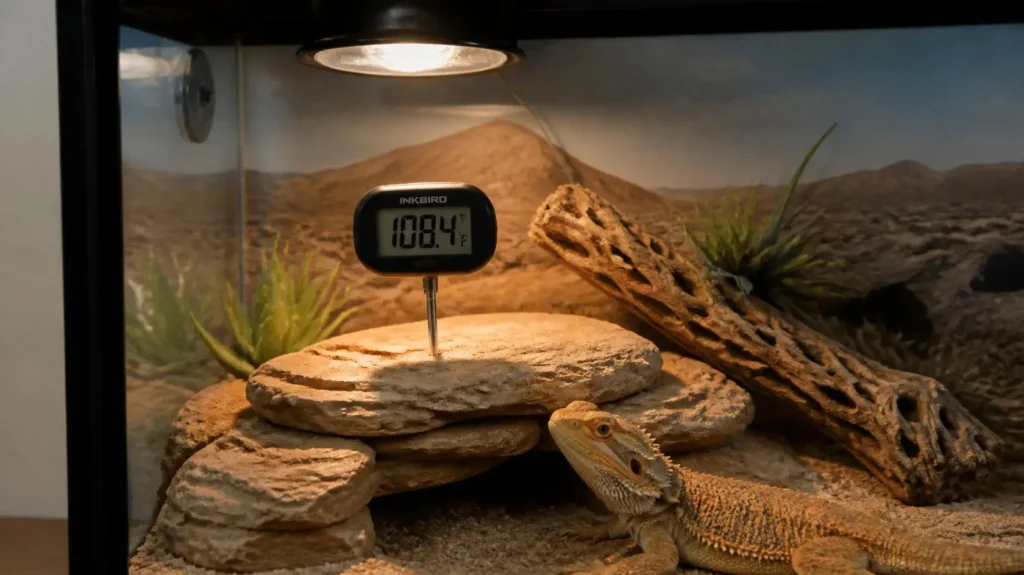
PVC panels, by contrast, are a much better insulator than glass, so less heat escapes through the enclosure walls and the internal temperature gradient stays more stable. Because PVC enclosures typically use a mostly solid construction with smaller ventilation points rather than a full mesh lid, heat has fewer places to escape. In practical terms, this means a PVC enclosure of the same size often needs a lower-wattage basking bulb, or less frequent thermostat cycling, to hold the RSPCA’s recommended basking zone of 38–42°C (100–107°F) than a comparable glass tank does.
That heat-retention advantage isn’t free, though. It comes with a trade-off that matters specifically for bearded dragons: humidity control.
Why This Matters More for Bearded Dragons Than Other Reptiles
Bearded dragons are a dry, arid-adapted species. The RSPCA’s care guidance states that low humidity is essential for bearded dragons to prevent skin or respiratory problems, and recommends a cool-end humidity of around 30–40%. That’s the opposite of what tropical, humidity-loving species like ball pythons or chameleons need — and it’s exactly where PVC’s biggest strength becomes a bearded dragon-specific caution. A sealed PVC enclosure that’s excellent for locking in humidity for a tropical species can just as easily trap excess humidity in a beardie’s enclosure if it isn’t properly ventilated, pushing conditions above the RSPCA’s recommended range.
The takeaway isn’t “avoid PVC for bearded dragons” — it’s that a PVC enclosure needs deliberate ventilation (vents, a mesh top panel, or a partially open lid) to avoid trapping humidity, while a glass tank’s mesh top handles ventilation for you by default but gives up heat retention in return.
Glass Tank vs PVC Enclosure: Side-by-Side Comparison
| Factor | Glass Tank | PVC Enclosure |
| Heat retention | Lower — heat escapes through walls and mesh top | Higher — solid panels insulate and hold warmth |
| Humidity control | Naturally low, matches beardie needs | Can run high unless vents are added |
| Visibility | Excellent, clear on all sides | Reduced — most panels are opaque |
| Weight | Heavy, harder to move once set up | Lighter, easier to relocate or reconfigure |
| Durability | Can crack or shatter on impact | Resists impact, won’t shatter |
| Upfront cost | Usually lower for smaller sizes | Usually higher, especially at larger sizes |
| Energy use | Higher — bulb works harder to hold basking temp | Lower — bulb needs less power for the same temp |
| Reptile stress (visibility) | Some dragons feel exposed on all sides | Opaque sides can feel more secure to some dragons |
How to Decide Which One Is Right for Your Setup
- Check your room’s ambient temperature. If your reptile room regularly drops below 20°C, PVC’s better heat retention will save you money on bulb wattage and reduce thermostat cycling.
- Confirm you can add ventilation to a PVC unit. If you’re considering PVC, make sure the model has adjustable vents or a mesh panel, since bearded dragons need that 30–40% humidity ceiling maintained.
- Weigh visibility against security. If you want to observe your dragon easily, or you’re housing it somewhere highly visible, glass’s all-around clarity may matter more to you than the small heat-retention gap.
- Factor in the size you need. The RSPCA‘s minimum enclosure size for one adult bearded dragon is 120 cm long x 60 cm wide x 60 cm high, and PVC enclosures are generally lighter and easier to source in this size without the weight glass carries at the same dimensions.
- Budget for the whole setup, not just the enclosure. A cheaper glass tank may need a stronger, more expensive basking bulb to compensate for heat loss, so compare total setup cost rather than sticker price alone.
Either material can support a healthy bearded dragon as long as the basking zone consistently hits the RSPCA’s recommended 38–42°C range and the enclosure meets the 120 x 60 x 60 cm minimum. The real decision usually comes down to how much you want to manage humidity manually versus lean on ventilation you don’t have to think about.
FAQ
Does a PVC enclosure need a stronger UVB bulb than glass? No — UVB strength depends on the bulb, its distance from the basking spot, and any mesh blocking it, not the enclosure material itself. If your UVB tube seems inconsistent regardless of enclosure type, read our guide on why your T5 UVB tube light is flickering to rule out a wiring or ballast issue.
Can I switch my bearded dragon from glass to PVC without other changes? You can, but expect to reduce your basking bulb wattage slightly and add ventilation, since PVC holds both heat and humidity more effectively than glass. Recheck the basking surface temperature with a digital thermometer for several days after the switch.
Is glass or PVC better for a baby bearded dragon? Either works, but many keepers start hatchlings in a smaller, easier-to-heat enclosure of either material and upgrade as the dragon grows, since a young dragon’s small body size means it loses heat faster in an oversized space.
My basking spot still isn’t holding temperature even in a PVC enclosure — what’s wrong? Enclosure material affects overall heat retention, but it won’t fix a bulb, thermostat, or thermometer that’s set up incorrectly. See our full troubleshooting guide on why your bearded dragon won’t use the basking spot for the most common causes.
Do bearded dragons need a different basking bulb wattage in a PVC enclosure? Often yes — a smaller PVC enclosure of the same footprint can typically hold the RSPCA’s 38–42°C basking range with a lower-wattage bulb than an equivalent glass tank, though you should always confirm with a digital infrared thermometer rather than assuming.

Haseeb Wattoo is the founder and author of Beardie Dragon Pro. He is passionate about bearded dragon care and shares practical, research-based guides on nutrition, habitat setup, health, behavior, and husbandry. His mission is to help reptile owners provide the best care for their pets through accurate, easy-to-understand, and trustworthy information. Haseeb aims to educate both beginners and experienced keepers, promoting responsible pet ownership and healthier, happier bearded dragons.