Quick Answer
If your bearded dragon’s tank is too humid even though you live in a dry climate, the humidity is almost always coming from inside the enclosure, not the outside air. The most common causes are a glass tank with a poorly ventilated screen top, an oversized water dish, damp or moisture-holding substrate, live plants, overly frequent misting, or a room humidifier running nearby. Bearded dragons need humidity around 30–40% (35–40% for hatchlings and juveniles). To fix it: improve airflow, switch to a smaller water dish, choose a drier substrate, remove or reduce misting, and confirm your hygrometer’s accuracy with a calibration test.
Why This Happens Even in a Dry Climate
It feels backwards. You live somewhere dry — Arizona, Nevada, inland Australia, the Middle East — and your home’s ambient humidity might sit at 15–25%. Yet your bearded dragon’s enclosure reads 55%, 60%, even higher. This confuses a lot of new keepers because they assume outdoor climate determines indoor tank conditions.
It doesn’t. An enclosure is a semi-sealed microclimate. Once you add a water dish, substrate, a basking lamp, and glass walls, you’ve created a small greenhouse that behaves nothing like the room around it. Dry outdoor air has almost no influence on a tank once these variables are introduced.
The real drivers of high tank humidity are almost always internal:
- Standing water evaporating into a semi-sealed space
- Substrate that holds moisture (coconut fiber, soil mixes, reptile carpet that’s been cleaned wet)
- Live plants releasing moisture through transpiration
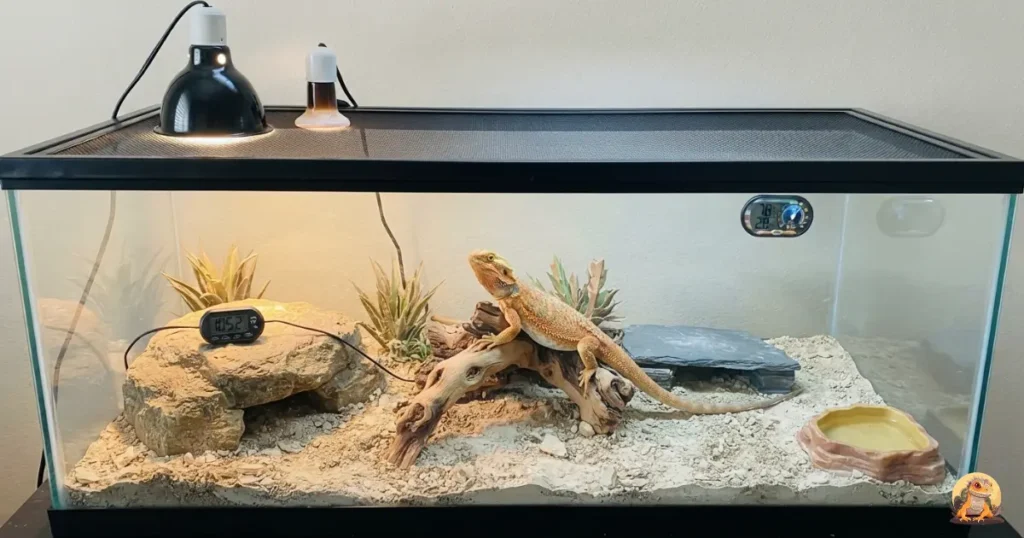
- A glass enclosure with a tight-fitting or partially blocked screen top
- Misting routines copied from tropical species care sheets
- A humidifier or essential oil diffuser running in the same room
- Heat lamps warming enclosure air, which then holds and later releases more moisture as it cools near the glass
Because bearded dragons are native to the arid interior of Australia, their captive environment needs to mimic that dryness — regardless of what the weather is doing outside your window.
What Humidity Level Bearded Dragons Actually Need
| Life Stage | Ideal Humidity Range | Notes |
|---|---|---|
| Hatchling (0–3 months) | 30–40% | Slightly higher end helps with shedding and hydration |
| Juvenile (3–12 months) | 30–40% | Same range, monitor shedding closely |
| Adult | 20–35% | Adults tolerate the drier end better than juveniles |
| Brumation period | 30–40% (brief spikes acceptable) | Reduced activity means less monitoring urgency, but avoid stagnant damp air |
Short-term spikes to 45–50% after misting or cleaning are not dangerous. The concern is sustained humidity above 40–50% for hours or days at a time, especially combined with poor airflow.
Symptoms of Too-High Humidity
Watch for these signs that your enclosure’s humidity has been too high for too long:
- Visible condensation on glass walls or the underside of the screen top
- Damp, musty, or ammonia-like odor from the enclosure
- Substrate that stays visibly wet or clumped instead of drying between cleanings
- Mold or fungal growth on wood, substrate, or decor
- Lethargy or reduced appetite in your dragon
- Discoloration or dark patches on the skin, particularly on the belly or toes (early scale rot)
- Labored or open-mouth breathing, wheezing, or nasal discharge (early respiratory infection signs)
- Retained shed that seems unusually soft or slow to come off (paradoxically, humidity that’s too low can also cause retained shed, so this symptom alone isn’t diagnostic — pair it with a hygrometer reading)
Step 1: Confirm Your Hygrometer Is Accurate
Before changing anything, verify the reading is real. Cheap analog dial hygrometers (the round stick-on type bundled with starter kits) are notoriously inaccurate, sometimes off by 15–20 percentage points.
Quick calibration test (salt test):
- Pour a small amount of table salt into a bottle cap and add a few drops of water to make it damp, not soaked.
- Place the cap and your hygrometer sensor together in a sealed sandwich bag for 8–12 hours.
- A properly calibrated hygrometer should read close to 75% inside the bag (this is the known equilibrium humidity of a saturated salt solution).
- If it reads significantly higher or lower, factor that offset into your enclosure readings, or replace it with a digital hygrometer.
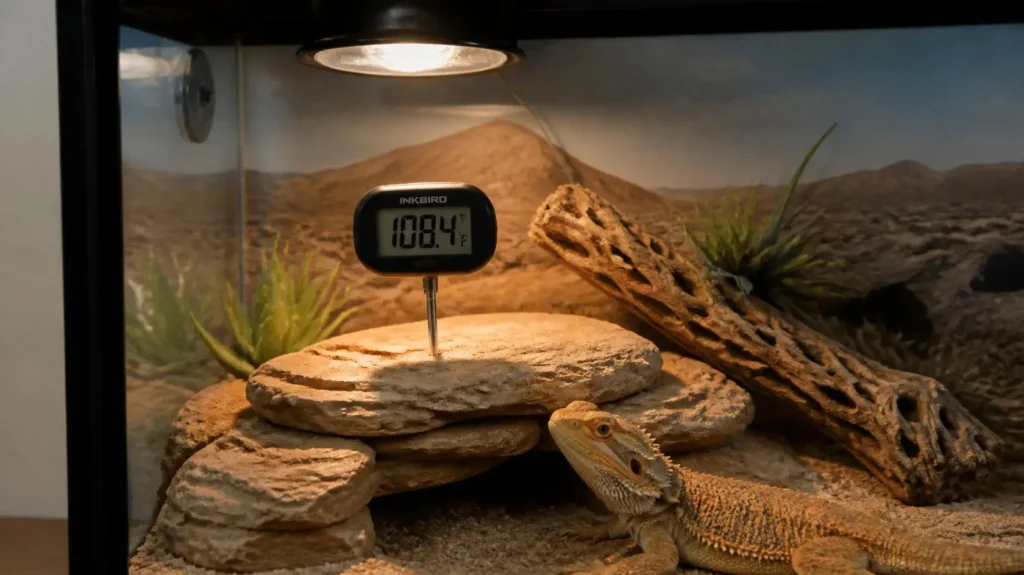
Best practice: use a digital hygrometer with a probe, placed at the level your dragon actually experiences (mid-enclosure, not up near the screen top where air is driest).
Step 2: Identify the Internal Moisture Source
Work through this checklist systematically rather than changing everything at once — that makes it impossible to know what actually fixed the problem.
- Water dish size: Is it larger than necessary? A dish should be just big enough for drinking and occasional soaking, not a small pond.
- Substrate type: Is it something that holds moisture (soil blends, coconut fiber/eco-earth, moss)? These are common in bioactive setups but release humidity steadily.
- Live plants: Real plants transpire moisture into the air continuously, even without direct misting.
- Misting habits: Are you misting daily “just in case,” following advice meant for tropical geckos or chameleons?
- Room conditions: Is a humidifier, essential oil diffuser, or even an open bathroom door adding moisture to the room the tank sits in?
- Recent cleaning: Did you just wipe down the glass or wash decor with water and put it back in wet?
Step 3: Fix Airflow and Ventilation
This is the single most overlooked fix. Even a small amount of internal moisture becomes a problem if it can’t escape.
- Increase screen top coverage. If part of your screen lid is covered with a solid panel (common for heat retention), uncover more of it, or use mesh across the entire top.
- Add side ventilation if your enclosure design allows it. PVC enclosures often have adjustable vents; glass tanks typically rely on the top only.
- Avoid overcrowding decor that blocks airflow across the substrate surface.
- Position the enclosure away from humid room sources — not next to a bathroom, kitchen, laundry area, or humidifier.
- Use a small clip-on fan aimed near (not directly into) the enclosure to encourage air exchange in the room, if the room itself tends to trap moisture.
Step 4: Adjust Water, Misting, and Substrate
| Change | From | To |
|---|---|---|
| Water dish | Large or deep bowl | Small, shallow dish sized for drinking only |
| Misting frequency | Daily or multiple times daily | Rarely, and only if shedding-related dryness is a documented issue |
| Substrate | Coconut fiber, soil mix, moss | Non-particulate options like reptile-safe tile, slate, or paper-based liners; if using loose substrate, choose ones formulated for arid species |
| Live plants | Moisture-loving tropical plants | Drought-tolerant, arid-adapted plants (or artificial plants) if live greenery is desired |
| Cleaning routine | Wiping with wet cloth and closing tank immediately | Wiping down, then leaving the screen top fully open for 15–20 minutes to dry before closing |
If you’re running a bioactive enclosure with a cleanup crew (isopods, springtails), a total switch away from moisture-retentive substrate isn’t practical — in that case, focus more heavily on ventilation and a properly sized, well-drained substrate layer instead of eliminating moisture-holding elements entirely.
Step 5: Manage Heat and Condensation
Heat and humidity interact. Warm air holds more moisture, and when that warm, humid air contacts a cooler glass wall, it condenses — which is why you often see droplets on the glass in the evening after lights turn off and temperatures drop.
- Make sure your basking bulb and any heat mat are appropriately sized for the enclosure (oversized heating can create larger warm-air pockets that hold more moisture).
- Check that your cool side temperature isn’t dramatically colder than the basking side in a way that encourages condensation on that end of the tank.
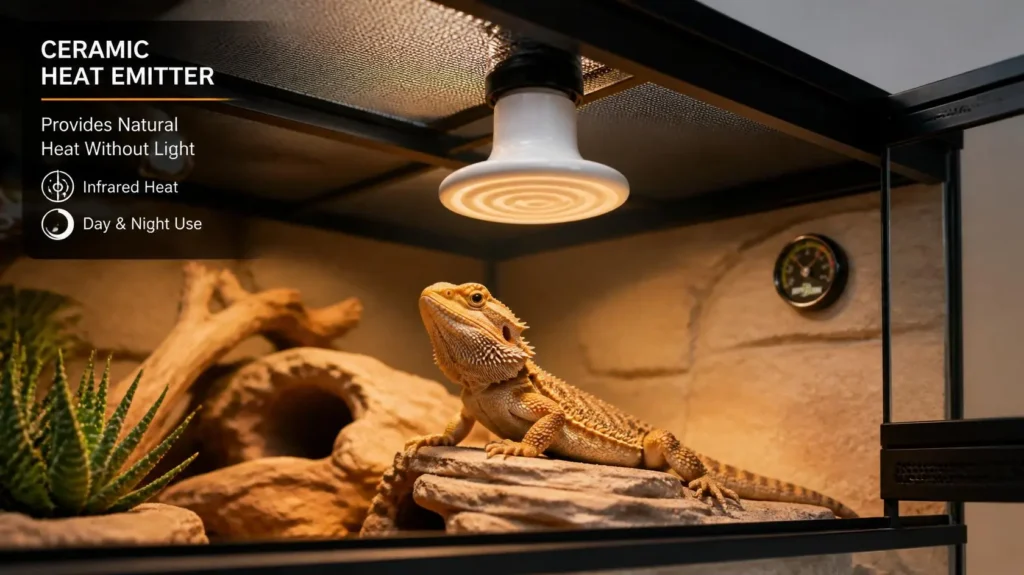
- If you use a ceramic heat emitter or heat lamp overnight, confirm it isn’t creating a humid, stagnant pocket near the substrate.
Comparison: Glass vs. PVC vs. Screen Enclosures for Humidity Control
| Enclosure Type | Humidity Retention | Ventilation | Best For |
|---|---|---|---|
| Glass tank with screen top | Moderate-high (traps moisture unless top is fully open) | Limited to top only | Budget setups; requires vigilant ventilation management |
| PVC enclosure | High (very good at holding heat and humidity) | Adjustable vents (if included) | Keepers who want precise climate control; requires deliberate venting for arid species |
| Wood/melamine with screen front | Low-moderate | Generally good, especially with front screen | Naturally drier setups; may need help holding heat |
| All-screen enclosure | Very low | Excellent | Only appropriate in warm, humid climates as-is; usually too dry-and-drafty without modification elsewhere, but never a humidity problem |
Prevention Checklist
Use this as an ongoing maintenance list:
- Digital hygrometer with probe placed at dragon’s level
- Hygrometer calibration checked at least once
- Water dish appropriately small
- Substrate is arid-appropriate or well-ventilated if bioactive
- No live tropical plants unless offset by strong ventilation
- Misting limited to shedding-support only, not routine
- Screen top mostly or fully uncovered
- Enclosure placed away from bathrooms, kitchens, humidifiers
- No visible condensation on glass in the morning
- Substrate feels dry to the touch within a few hours of any cleaning

Common Mistakes Owners Make
- Copying tropical species care sheets. Advice for chameleons, crested geckos, or tropical species often recommends daily misting — this is inappropriate for an arid species like a bearded dragon.
- Covering too much of the screen top for heat retention. This traps humidity along with heat.
- Using a large, deep water dish “just in case,” which evaporates far more surface area than necessary.
- Assuming a dry climate outside means the tank is automatically dry inside. As covered above, the two are largely disconnected once the enclosure is set up.
- Not verifying hygrometer accuracy, leading to chasing a problem that may not exist — or missing one that does.
- Changing multiple variables at once, making it impossible to identify which fix worked.
When High Humidity Becomes a Health Emergency
Sustained high humidity combined with poor ventilation is linked to two serious conditions in bearded dragons. If you notice the following, contact a reptile-experienced veterinarian promptly:
- Respiratory infection signs: open-mouth breathing, audible clicking or wheezing, mucus around the nose or mouth, lethargy, and loss of appetite.
- Scale rot (dermatitis/necrosis): discoloration, blistering, or a foul smell on the belly, toes, or tail, often from prolonged contact with damp substrate.
These are not conditions to self-diagnose or self-medicate. This article is educational and does not replace a veterinary exam. If your dragon shows any of the signs above, seek care from a veterinarian experienced with reptiles as soon as possible — early treatment significantly improves outcomes for both conditions.
Decision Tree: Diagnosing Your Humidity Problem
Is your hygrometer digital and recently calibrated?
├── No → Calibrate or replace it first. Re-check readings before proceeding.
└── Yes → Is humidity consistently above 40–50% for hours at a time?
    ├── No, only brief spikes after misting/cleaning → Normal. No action needed.
    └── Yes → Is the screen top mostly covered or blocked?
        ├── Yes → Uncover more of the top. Re-check in 24 hours.
        └── No → Is there a large water dish, live plants, or moisture-retentive substrate?
            ├── Yes → Downsize water dish, adjust substrate, reduce/remove misting.
            └── No → Check the room itself for humidifiers, proximity to bathrooms/kitchens,
                     or general room humidity. Relocate enclosure if needed.
Expert Tips
- Measure at dragon-level, not lid-level. Air near an open screen top always reads drier than air near the substrate — that gap can be 10–15 percentage points.
- Track humidity at the same time each day for a week before making changes, so you understand your baseline rather than reacting to a single high reading.
- A slightly humid morning is often normal, especially after overnight temperature drops cause minor condensation; the concern is humidity that doesn’t return to baseline once lights and heat are back on.
- If you keep a bioactive enclosure, prioritize a proper drainage layer and springtail/isopod activity to process moisture, rather than eliminating humidity-holding elements you need for the ecosystem to function.
1. Can a bearded dragon get sick from a tank that’s too humid?
Yes. Prolonged high humidity is associated with respiratory infections and scale rot (skin infection from damp substrate contact). Both require veterinary attention if you suspect them.
2. Why is my tank humid if my house’s air is dry?
Because the enclosure functions as its own sealed microclimate. Water dishes, substrate, plants, and heat sources generate and trap moisture regardless of the humidity in the room or outside.
3. What’s the ideal humidity for a bearded dragon?
Generally 30–40% for juveniles and hatchlings, and 20–35% for adults, though brief fluctuations outside this range are normal and not harmful.
4. Do bearded dragons need misting?
Not routinely. Occasional light misting can help during shedding, but daily misting is more appropriate for tropical species and can push humidity too high for a desert species.
5. What substrate keeps humidity lowest?
Non-particulate options like reptile-safe tile, slate, or paper-based liners hold essentially no moisture. If using loose substrate, choose blends specifically formulated for arid or desert species rather than tropical bioactive mixes.
6. Should I remove the water dish to lower humidity?
No — bearded dragons need constant access to fresh water. Instead, downsize the dish so less surface area is evaporating, and check it isn’t spilling into the substrate.
7. Is condensation on the glass always a problem?
Not necessarily. Light morning condensation from overnight temperature drops is common. Persistent condensation throughout the day, or condensation combined with a musty smell, indicates a real ventilation or moisture problem.
8. Can live plants cause high humidity?
Yes. Live plants release moisture through transpiration continuously, which can meaningfully raise enclosure humidity, especially in a poorly ventilated tank.
9. How do I know if my hygrometer is lying to me?
Run a salt calibration test (described in Step 1 above). Analog dial hygrometers included in starter kits are frequently inaccurate by a wide margin.
10. Will a bigger enclosure fix a humidity problem?
Not by itself. A larger enclosure can dilute moisture somewhat, but the underlying source (water, substrate, plants, ventilation) still needs to be addressed regardless of tank size.
11. Can a humidifier in the room affect the tank even if it’s not aimed at it?
Yes. Room humidity does factor in when the enclosure has any ventilation at all (which it should), so a humidifier running nearby can raise tank humidity over time.

Haseeb Wattoo is the founder and author of Beardie Dragon Pro. He is passionate about bearded dragon care and shares practical, research-based guides on nutrition, habitat setup, health, behavior, and husbandry. His mission is to help reptile owners provide the best care for their pets through accurate, easy-to-understand, and trustworthy information. Haseeb aims to educate both beginners and experienced keepers, promoting responsible pet ownership and healthier, happier bearded dragons.