Quick Answer
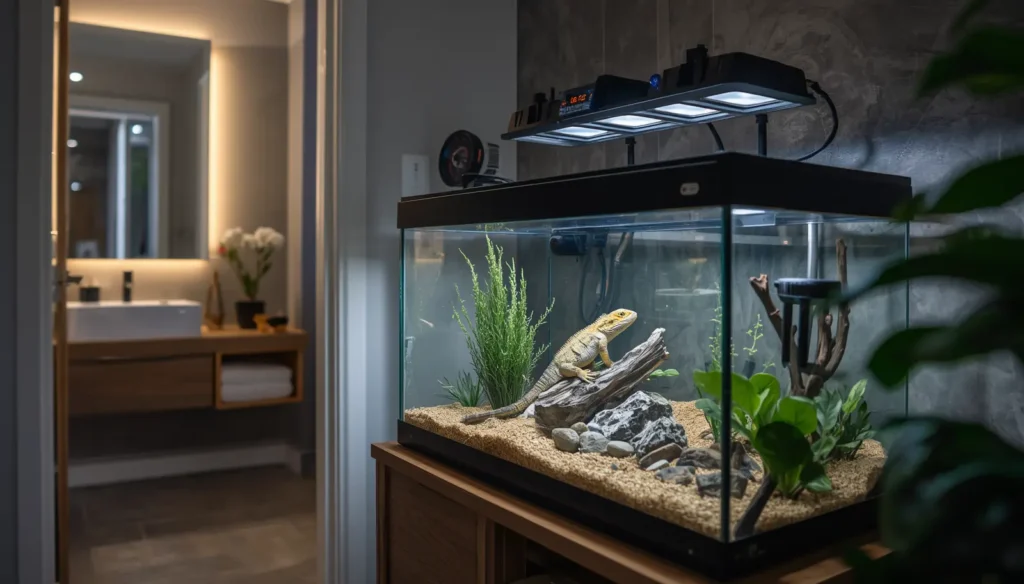
Yes, in most homes you can put a bearded dragon enclosure in a room next to a bathroom. Proximity on the floor plan isn’t the risk factor — shared air is. What matters is whether humidity, cold drafts, or cleaning-product fumes from the bathroom regularly reach the room where the enclosure sits. A guest room a few steps from a bathroom, with the door usually closed, is typically fine. A room that shares a poorly sealed wall or vent with a steamy shower, or that gets a cold draft every time the bathroom door opens, needs a fix before setup — not a different house.
Fast fact: Husbandry and veterinary sources generally place a bearded dragon’s enclosure humidity target around 20–40% during the day, with brief nighttime rises up to roughly 50–55% considered normal. Sustained readings well above that — especially near 70% with visible condensation — are consistently flagged as a risk factor for respiratory and skin problems. The room around the enclosure doesn’t need to hit that exact number, but a room that stays persistently damp makes it much harder to keep the enclosure itself in a healthy range.
A note on sources: Humidity and temperature figures in this guide reflect a consensus across veterinary care sheets (including PetMD’s veterinary-reviewed care guide) and published husbandry references, which converge on an enclosure humidity target in the 20–40% (day) to roughly 50–55% (brief nighttime) range, with concern rising sharply as readings approach 70%. Where sources vary slightly, we’ve used the more conservative end of the range. This article does not replace advice from a reptile veterinarian who can assess your specific animal and setup.
1. Why This Question Matters
Bearded dragons come from the arid interior of Australia. In the wild, they live in environments with low ambient humidity (usually 20–35%), big daily temperature swings between basking spots and shade, and dry, moving air. Their bodies are built for that. A home environment that drifts too far from this — especially one that’s consistently damp or drafty — puts them at risk for respiratory infections, skin problems, and stress.
Bathrooms are one of the few rooms in a house that regularly produce sudden humidity spikes (from showers) and, in older or poorly insulated homes, temperature swings (cold tile, exhaust fans pulling air). That’s why people ask this question — not because “bathroom” is a scary word, but because bathrooms are humidity generators.
2. The Real Issue: It’s Not “Bathroom-Adjacent,” It’s Microclimate
Here’s the thing most articles skip: proximity to a bathroom on a floor plan tells you almost nothing on its own. What actually matters is:
- Whether the two rooms share airflow (an open door, a vent, a gap under a door, a shared HVAC return)
- How well insulated and sealed the shared wall is
- Whether the bathroom has a working exhaust fan
- How often and how long the bathroom is used for showers/baths
- Whether the enclosure sits near that shared wall or far from it
A bedroom two doors down from a bathroom, with its own door kept closed, is functionally no different from a bedroom on the other side of the house. Meanwhile, a home office right next to a bathroom with no fan and the door always cracked open could develop humidity problems even though it’s “just next door.”
In short: distance on the floor plan is a proxy, not the actual variable. The actual variable is shared air.
3. How Bathrooms Affect Nearby Rooms
Humidity spikes
A single hot shower can push bathroom humidity to 80–100% for 20–30 minutes. Without a working exhaust fan, that moist air has to go somewhere — often under the door and into the hallway or adjoining room. Reptile enclosures are usually sealed glass or PVC boxes, so a brief humidity spike in the room usually doesn’t reach the animal directly. But it can:
- Raise ambient humidity inside the enclosure over time if the room stays damp
- Encourage mold or mildew growth on substrate, decor, or the enclosure’s wood/fabric parts
- Make it harder for the enclosure’s humidity to drop overnight, which bearded dragons need
Temperature swings
Bathrooms are often the coldest room in a house in winter (tile floors, exterior walls, exhaust fans pulling in outside air) and the most humid in general. Cold air seeping through gaps under doors can create drafts in the adjoining room.
Chemical fumes
Cleaning products (bleach, ammonia-based cleaners, air fresheners, aerosol sprays) used in bathrooms can off-gas into nearby rooms. Bearded dragons have sensitive respiratory systems, and airborne chemical irritants are a genuine and often overlooked risk — arguably a bigger concern than the humidity itself.
Noise and vibration
Less biologically dangerous but still relevant: exhaust fans, plumbing, and toilet flushing can be a low-grade, chronic stressor for an animal that startles easily.
4. Signs Your Room Is a Bad Fit
Watch for these before you set up the enclosure — or reassess if it’s already there:
- The room’s ambient humidity sits above 55–60% for long stretches, even with the door closed
- Windows or mirrors in the adjoining room fog up after showers and stay foggy for a while
- You can feel a temperature drop near the shared wall or under the door
- You notice a chemical or “clean” smell drifting into the room after bathroom use
- The enclosure’s substrate feels damp, or you see glass condensation your misting/humidifier can’t explain
- Mold or a musty smell develops in the room over time
- If none of these apply, the room is very likely fine.

5. Step-by-Step: How to Test Your Room Before You Commit
- Place a digital hygrometer/thermometer in the room, at the height and location where the enclosure will sit.
- Log readings for 3–5 days, including at least one day with normal bathroom use (showers, baths).
- Check readings right after a shower and again 30–60 minutes later, to see how fast the room recovers.
- Check for drafts by holding a lit incense stick or a tissue near door gaps and shared walls.
- Compare to a sensible target range: aim for the room’s ambient humidity to sit somewhere in the 30–50% range most of the time, with brief spikes after a shower that recover within 30–60 minutes. Ambient temperature shouldn’t swing more than a few degrees when doors open and close.
- Repeat in a different season if possible — winter drafts and summer humidity behave differently.
6. How to Fix a Bathroom-Adjacent Room
If your testing shows a problem, you usually don’t need to move rooms — you need to fix the airflow:
| Problem | Fix |
|---|---|
| Humidity creeps up after showers | Install or run a bathroom exhaust fan; keep the bathroom door closed during and after showers |
| Draft under the shared door | Add a door draft stopper/sweep to the bathroom door |
| Cold spot near shared wall | Move the enclosure a few feet away from that wall; add a small space heater or adjust the enclosure’s heating to compensate on that side |
| Chemical smell drifting in | Switch to unscented, reptile-safe cleaning products; avoid aerosol sprays and plug-in air fresheners near the enclosure; ventilate the bathroom before opening doors fully |
| Long-term dampness/mold smell | Run a dehumidifier in the shared hallway or room; check for plumbing leaks |
None of these require an expensive renovation. Most are $10–$40 fixes (door sweep, exhaust fan timer, unscented cleaner).
7. Rooms to Avoid Regardless of Bathroom Proximity
Some room characteristics matter more than bathroom proximity ever will:
- Kitchens — grease, aerosolized cooking fumes, and temperature spikes from ovens
- Rooms with no climate control (garages, sunrooms, unfinished basements) — temperature swings far outside a dragon’s tolerance
- Rooms with direct, uncontrolled sunlight on the enclosure — can cause dangerous overheating
- Laundry rooms — dryer sheet fumes and heat/humidity from washers and dryers
- Rooms near exterior doors — frequent drafts
If you’re choosing between “bathroom-adjacent bedroom” and “laundry room,” the bedroom wins easily.
8. Comparison Table: Good vs. Risky Placement
| Factor | Good Placement | Risky Placement |
|---|---|---|
| Ambient humidity | Roughly 30–50%, recovers within an hour after spikes | Consistently above 55–60%, slow to recover, visible condensation |
| Temperature stability | Stays within a few degrees all day | Swings 10°+ with door opening/closing |
| Airflow with bathroom | Door usually closed, fan used | Doors often open, no exhaust fan |
| Chemical exposure | Unscented cleaners, good ventilation | Aerosols, scented sprays, poor ventilation |
| Direct sunlight | No direct hot sun on enclosure | Enclosure sits in a sunbeam part of the day |
| Foot traffic/noise | Moderate, predictable | Constant slamming doors, loud fans |
9. Decision Tree: Should You Use This Room?
- Does the room share an open vent, gap, or frequently open door with the bathroom?
- No → Likely fine. Proceed to setup.
- Yes → Continue.
- Does the bathroom have a working exhaust fan that’s actually used consistently?
- Yes → Likely fine with minor precautions (door sweep, unscented cleaners).
- No → Continue.
- Did your 3–5 day hygrometer test show humidity spikes that don’t recover within roughly an hour, or readings that stay above 55–60% for long stretches?
- No → Room is probably usable with basic fixes.
- Yes → Address ventilation first (fan, door sweep, dehumidifier) before setting up the enclosure, or choose a different room.
10. Common Mistakes Owners Make
- Assuming “next door” automatically means “bad.” Airflow matters far more than floor-plan distance.
- Placing the enclosure directly against the shared wall. Even a few feet of distance reduces draft and temperature exposure.
- Using scented cleaning products in the bathroom without thinking about airflow into the reptile room.
- Skipping the test period. Guessing instead of measuring humidity and temperature leads to avoidable problems.
- Overcorrecting with a running dehumidifier 24/7, which can dry the room too much and make maintaining enclosure humidity (needed for shedding) harder.

11. Expert Tips
- Keep a small hygrometer permanently in the room, not just during testing — conditions change with seasons.
- A door sweep on the bathroom door is often more effective than anything done to the reptile room itself.
- If you must use the room and airflow can’t be fully controlled, consider a bearded dragon enclosure design with a solid back and side panels (rather than full mesh) facing the shared wall, to reduce draft exposure.
- Unscented, reptile-safe cleaners are worth the switch even if you never see a problem — it removes one variable permanently.
12. When to Call a Vet
Room placement issues can contribute to health problems, but they don’t cause them overnight. Contact a reptile veterinarian promptly if you notice:
- Open-mouth breathing, wheezing, or clicking sounds when breathing
- Nasal or mouth discharge
- Lethargy combined with reduced appetite
- Visible mold or a persistent musty smell inside the enclosure
- Skin discoloration or unusual shedding patterns that coincide with a damp environment
These can indicate a respiratory infection or skin condition, which require professional diagnosis and treatment. This article is educational and does not replace veterinary care.
FAQs
1. Is it dangerous to keep a bearded dragon right next to a bathroom wall?
Not inherently. What matters is whether that wall lets humidity or drafts through, not the bathroom’s presence itself.
2. Will shower steam get into the enclosure and hurt my bearded dragon?
Direct steam reaching a sealed enclosure is unlikely. The bigger risk is a room that stays humid over time, which can gradually raise ambient conditions inside the enclosure.
3. Does the bathroom need an exhaust fan for the room next door to be safe?
It’s the single most effective fix if you’re seeing humidity problems. Many bathrooms without one develop noticeably higher ambient humidity in adjoining rooms.
4. Can I use a bedroom that shares a bathroom (like an en-suite) for the enclosure?
Generally not recommended without significant airflow control, since en-suite bathrooms share air very directly with the bedroom.
5. What humidity level is too high for a bearded dragon’s room?
There’s no single official number for the room (as opposed to the enclosure), but a practical warning sign is ambient humidity that sits above 55–60% for long stretches, or that doesn’t recover within an hour or two after a shower. For reference, most husbandry and veterinary sources put the enclosure’s own target around 20–40% by day, so a room that’s chronically damper than that works against you.
6. Are cleaning product fumes from the bathroom actually a real risk?
Yes — airborne irritants from bleach, ammonia, and aerosol sprays can affect a bearded dragon’s respiratory system, and this is often overlooked compared to humidity concerns.
7. Should I run a dehumidifier in the room full-time to be safe?
Only if testing shows a genuine humidity problem. Running one unnecessarily can dry the room too much, which can make shedding harder for your dragon.
8. How long should I test a room before setting up the enclosure?
At least 3–5 days, including days with normal bathroom use, ideally repeated in a different season if you have time.
9. Is a hallway bathroom worse than an en-suite bathroom for this purpose?
Usually the opposite — hallway bathroom doors tend to stay closed more often and have better-defined airflow boundaries than en-suite bathrooms, which share air with a bedroom more directly.
10. What’s more important: distance from the bathroom, or the room’s own climate control?
The room’s own climate control (heating, ventilation, sunlight exposure) almost always matters more than proximity to a bathroom.
11. Can I fix a bathroom-adjacent room instead of moving the enclosure?
In most cases, yes. A door sweep, an exhaust fan, and switching to unscented cleaners solve the vast majority of cases.
12. Does the enclosure itself protect my bearded dragon from room humidity?
Partially. A glass or PVC enclosure buffers short-term spikes, so one steamy shower usually isn’t a crisis. But enclosures aren’t airtight — they need ventilation to work properly — so a room that’s chronically humid will gradually pull the enclosure’s baseline humidity up over time, making it harder to keep in the healthy range.
14. Key Takeaways
- Bathroom proximity isn’t the real risk factor — shared airflow, humidity, and chemical exposure are.
- Test the room with a hygrometer and thermometer for several days before deciding.
- A working exhaust fan and a door sweep solve most bathroom-adjacent placement issues.
- Kitchens, laundry rooms, and rooms with no climate control are riskier than a well-managed bathroom-adjacent room.
- Watch for respiratory symptoms and consult a reptile vet promptly if they appear.
15. Conclusion
A room next to a bathroom is not automatically off-limits for a bearded dragon enclosure. What decides whether it works is airflow, humidity recovery time, drafts, and chemical exposure — not the label “bathroom-adjacent” itself. Test the room for a few days with a real hygrometer, fix the airflow if the numbers say you need to, and keep the enclosure a little distance from any shared wall. Do that, and most bathroom-adjacent rooms make a perfectly good, safe home for your bearded dragon — no renovation or room swap required.

Haseeb Wattoo is the founder and author of Beardie Dragon Pro. He is passionate about bearded dragon care and shares practical, research-based guides on nutrition, habitat setup, health, behavior, and husbandry. His mission is to help reptile owners provide the best care for their pets through accurate, easy-to-understand, and trustworthy information. Haseeb aims to educate both beginners and experienced keepers, promoting responsible pet ownership and healthier, happier bearded dragons.