Quick Answer
Yes, a bearded dragon hiding all day in a new setup is usually normal for the first one to two weeks. This is a well-recognized response called relocation stress, and it happens because a new enclosure changes almost everything a dragon uses to feel safe — smell, sightlines, temperature zones, and hiding spots — all at once. It only becomes a real problem if the hiding continues well past two weeks, or if it’s paired with appetite loss, weight loss, lethargy, or refusal to bask at all.
What “Hiding All Day” Actually Means
Before deciding whether hiding is a problem, it helps to define what counts as normal hiding versus excessive hiding.
Normal hiding looks like a dragon that retreats to a hide box, cave, or under a hammock for long stretches, but still comes out briefly to bask, investigate its new surroundings, or check on food. Over several days, the time spent out slowly increases.
Excessive or concerning hiding looks like a dragon that stays completely tucked away around the clock, shows no interest in basking even when temperatures are correct, and doesn’t seem to be gradually improving day over day.
The difference isn’t really about how many hours are spent hiding on any single day — it’s about the trend. A bearded dragon hiding all day in a new setup during week one is expected. The same behavior continuing unchanged into week three is a signal something else is going on.
Why Bearded Dragons Hide in a New Setup
A bearded dragon doesn’t understand that a new tank is an upgrade. To your dragon, it’s simply unfamiliar territory, and unfamiliar territory triggers a very old survival instinct: stay hidden until the environment is proven safe.
This response is well documented across reptile behavior and veterinary husbandry guidance and is commonly referred to as relocation stress. Every part of a new enclosure is unfamiliar at once — new scent, new sightlines, a different basking spot location, and hiding options in unfamiliar places — so a dragon’s instinct is to retreat rather than explore.
This is not a sign of a “damaged” or unusually anxious dragon. It’s a normal, species-typical response, and it resolves on its own in the vast majority of healthy dragons once the new setup is confirmed safe through repeated, uneventful exposure.
How Long Is Normal? A Realistic Timeline
Here’s a general breakdown of what to expect. These are typical ranges, not fixed rules — every dragon settles at its own pace.
| Timeframe | What’s Typical |
|---|---|
| Day 1–2 | Little to no time out of the hide is common; some dragons won’t emerge at all except briefly |
| Day 3–5 | Short basking sessions may start appearing, often brief and cautious |
| Week 1 | Gradually increasing time spent out, especially near the basking light |
| Week 2 | Most healthy dragons are exploring and basking close to their normal routine |
| Past 2 weeks | Continued near-constant hiding warrants a closer look at husbandry, or a vet check if other symptoms are present |
Juveniles and hatchlings often settle a little faster than adults, sometimes within a week, because they explore new environments more readily. Adults — especially those moved from a long-established setup — can take closer to the full two weeks. A dragon moved during cooler months may also show longer hiding stretches related to natural seasonal slow-down, which is a separate topic worth understanding on its own.
Normal Hiding vs. a Real Problem
Use this comparison to sanity-check what you’re seeing before assuming the worst.
| Sign | Likely Normal Adjustment | Likely a Real Problem |
|---|---|---|
| Hiding pattern | Gradually less hiding, more time out each day | No change day to day, or getting worse |
| Basking | Brief basking sessions appear within the first week | No basking at all, even with correct temperatures |
| Appetite | Reduced but slowly returning | No interest in food past 1–2 weeks |
| Body condition | Stable weight | Visible weight loss, sunken tail base |
| Activity when out | Alert, investigates surroundings | Lethargic, unresponsive, eyes half-closed |
| Response to touch/sound | Freezes briefly, resumes activity | Stays motionless for extended periods, doesn’t react normally |
If your dragon is hiding but still comes out to bask and shows interest in food, even briefly, that’s a good sign the adjustment is progressing normally.
Other Reasons a Bearded Dragon Hides Besides a New Setup
A new enclosure is one of the most common triggers for excessive hiding, but a move often exposes a setup issue that was already marginal. Rule these out alongside the normal adjustment window:
- Basking temperature too low. If the hot spot isn’t warm enough, a dragon may avoid it entirely and stay hidden in a cooler, “safer-feeling” spot instead of basking where it should.
- UVB or basking light positioned incorrectly. Lighting that’s too dim, too intense, or mounted at the wrong distance can make the basking area feel uncomfortable rather than inviting.
- Not enough hides, or hides in the wrong spot. Paradoxically, a dragon with too few places to retreat can become more defensive and hide in whatever spot is available, even if it’s not ideal.
- Enclosure placed somewhere loud or high-traffic. Constant noise, footsteps, or activity near the tank keeps a dragon in a defensive state longer than a quiet location would.
- Recent handling during the adjustment period. Well-intentioned handling right after a move often extends hiding behavior rather than reducing it.

- Illness or injury. Hiding paired with lethargy, appetite loss, or physical changes can indicate a health issue unrelated to the move itself.
- Seasonal brumation. Bearded dragons can show natural, temporary drops in activity and increased hiding during shorter daylight months, separate from any enclosure change.
- Shedding. A dragon preparing to shed may hide more and show duller skin color, independent of the new setup.
Step-by-Step: Helping a Hiding Dragon Come Out Naturally
Step 1: Confirm the Basking Temperature First
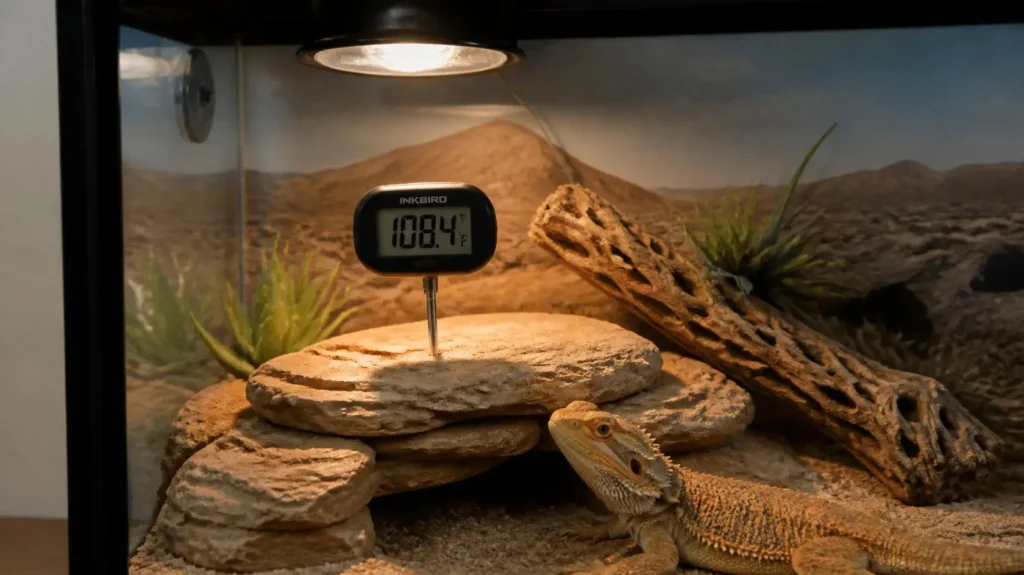
Before assuming it’s “just stress,” check the basking surface temperature with a digital probe thermometer. A hot spot that’s too cool gives a dragon no real reason to come out and bask.
Step 2: Leave the Enclosure Completely Alone for a Few Days
Avoid rearranging decor, adding new items, or repeatedly opening the enclosure to check in. Every change resets part of the adjustment process.
Step 3: Reduce Handling to the Minimum
Skip handling entirely for the first several days to a week unless necessary. Frequent handling during this window tends to prolong hiding rather than build comfort.
Step 4: Keep the Room Quiet and Predictable
Move the enclosure away from loud noise and heavy foot traffic if possible, and keep the lighting schedule exactly consistent day to day.
Step 5: Offer Food on a Normal Schedule Without Forcing It
Continue regular feeding times, but don’t be discouraged by a dragon that ignores food for the first several days — this is a normal part of the same adjustment process.
Step 6: Observe From a Distance
Watch quietly for basking attempts and general alertness rather than opening the tank repeatedly. Simply being present near the glass too often can read as a disturbance.
Step 7: Track Progress Over Days, Not Hours
A single quiet day means very little. What matters is whether time spent hiding is trending down across the week.
Checklist: Ruling Out Setup Problems
- Basking surface temperature confirmed with a digital probe thermometer (not a stick-on dial)
- Cool-side temperature gives a real gradient, not just a slightly cooler hot side
- UVB bulb is the correct type and mounted at the right distance
- At least one hide available on both the warm and cool side
- Enclosure located in a quiet, low-traffic area
- Handling minimized for the first several days to a week
- Feeding offered on a normal schedule without forcing
- No sudden changes to lighting schedule or decor since the move
Common Mistakes That Make Hiding Worse
- Reaching into the enclosure repeatedly to “check on” the dragon. This keeps the environment unpredictable exactly when consistency is needed most.
- Handling daily to “build trust” during the adjustment period. This usually backfires and extends hiding behavior.
- Rearranging decor again shortly after the move. Any change resets part of the process a dragon has already started adjusting to.

- Assuming hiding is always just stress and skipping a temperature check. A basking spot that isn’t hot enough will keep a dragon hiding regardless of how much time passes.
- Panicking after a single day of no visible activity. One quiet day is not a pattern — give it time before judging.
- Ignoring hiding that continues unchanged for weeks. Persistent, unimproving hiding past two weeks deserves a closer look, not more patience alone.
Decision Tree: Should You Be Worried?
- Has it been less than two weeks since the move, and is your dragon coming out briefly to bask or investigate food?
- Yes → This is a normal adjustment. Continue the routine and give it more time.
- No, it’s been over two weeks with no improvement → Recheck temperatures, UVB placement, and enclosure location before assuming it’s simply taking longer than usual.
- Is your dragon hiding along with appetite loss, weight loss, or lethargy when it does come out?
- No → Likely normal relocation stress.
- Yes → This combination warrants a husbandry review and a call to a reptile-experienced vet, since it may point to an issue beyond adjustment stress.
When to Call a Reptile Vet
Reach out to a reptile-experienced veterinarian if your dragon’s hiding is paired with any of the following:
- No food intake for more than about a week (juveniles) or two weeks (adults)
- Visible weight loss or a noticeably thin tail base
- Lethargy, sunken eyes, or unresponsiveness when handled
- Refusal to drink water alongside refusal to eat
- No basking at all despite confirmed correct temperatures
- Abnormal stool, breathing, or movement

This article is intended for general education and isn’t a substitute for a hands-on veterinary exam. A vet can rule out illness, parasites, or impaction, which can look similar to ordinary relocation stress in the early stages but require a different response.
FAQs
Is it normal for a bearded dragon to hide all day after moving to a new tank?
Yes, this is common in the first one to two weeks and is known as relocation stress. Most healthy dragons gradually spend more time out as they confirm the new environment is safe.
How long should I wait before worrying about a hiding bearded dragon?
Give it a full two weeks before being concerned, as long as your dragon is showing brief basking attempts and some interest in food during that window.
Should I take my bearded dragon out of its hide to make it adjust faster?
No. Forcing a dragon out of its hide or handling it frequently during the adjustment period usually prolongs hiding rather than resolving it.
My bearded dragon won’t come out even to bask — is that normal?
A brief period of skipping basking can happen in the first day or two, but if it continues for several days with correct temperatures confirmed, it’s worth rechecking your setup rather than waiting it out.
Can incorrect basking temperature cause a bearded dragon to hide more?
Yes. If the basking spot isn’t warm enough, a dragon has little reason to leave its hide, which can look identical to ordinary relocation stress but is actually a setup issue.
Does hiding all day mean my bearded dragon is sick?
Not necessarily. Hiding alone, without appetite loss, weight loss, or lethargy, is usually just adjustment behavior. It becomes more concerning when paired with those additional signs.
Is it normal for a juvenile bearded dragon to hide more than an adult in a new setup?
Juveniles sometimes adjust faster than adults, though individual temperament plays a role. Watch the same signs — basking attempts, appetite, and activity trend — regardless of age.
Can too few hiding spots make hiding behavior worse?
Yes. A dragon without enough secure hiding options can become more defensive overall, so having at least one hide on both the warm and cool side actually supports faster adjustment.
Should I cover the sides of the tank to help my bearded dragon feel safer?
Some owners temporarily reduce visual exposure with a partial background or covering on the sides during the first week or two, which can reduce the sense of being out in the open.
How is relocation stress hiding different from brumation?
Relocation stress is tied to a new environment and typically improves within one to two weeks. Brumation is a seasonal slowdown that can include reduced activity and appetite over a longer period, often unrelated to any recent tank change.
What should I check first if my dragon is still hiding all day after two weeks?
Start with basking and cool-side temperatures using a digital probe thermometer, then check UVB placement and enclosure location, before considering illness as a possible cause.
Key Takeaways
- A bearded dragon hiding all day in a new setup for the first one to two weeks is a normal, well-recognized response called relocation stress.
- What matters is the trend — gradually decreasing hiding and increasing basking over several days — not the exact number of hours spent hidden on any single day.
- Confirm basking temperature, UVB placement, and hide availability early, since setup issues can look identical to ordinary adjustment stress.
- Minimize handling and avoid rearranging the enclosure during the first week or two to help the process move along naturally.
- Persistent hiding past two weeks, especially with appetite loss, weight loss, or lethargy, is a signal to move from patience to a husbandry review and a vet consultation.
Conclusion
A bearded dragon hiding all day in a new setup is, in most cases, exactly what it looks like: a normal, temporary caution response to unfamiliar territory. Give it the full one-to-two-week window, keep handling and enclosure changes to a minimum, and confirm the basics of temperature and lighting are correct rather than assuming stress explains everything. If hiding is easing up little by little and your dragon still shows brief basking or interest in food, you’re on track. If two weeks pass with no change, or hiding comes with appetite loss, weight loss, or lethargy, that’s your cue to check the setup closely and loop in a reptile-experienced vet.
This article is for general educational purposes and is not a substitute for personalized veterinary care. If your bearded dragon shows signs of illness or prolonged stress, consult a reptile-experienced veterinarian.

Haseeb Wattoo is the founder and author of Beardie Dragon Pro. He is passionate about bearded dragon care and shares practical, research-based guides on nutrition, habitat setup, health, behavior, and husbandry. His mission is to help reptile owners provide the best care for their pets through accurate, easy-to-understand, and trustworthy information. Haseeb aims to educate both beginners and experienced keepers, promoting responsible pet ownership and healthier, happier bearded dragons.