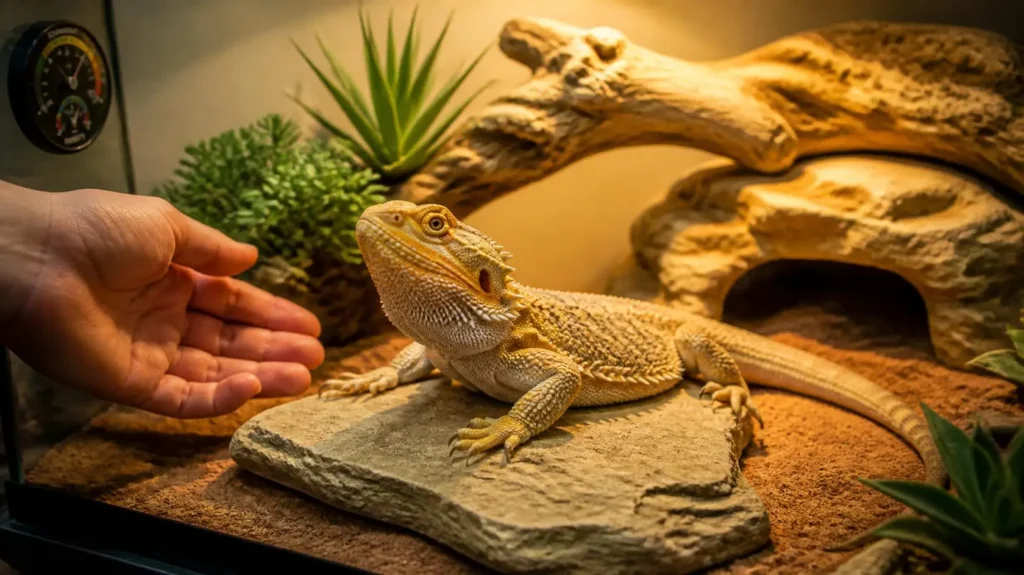
Quick Answer
To introduce a bearded dragon to a new enclosure without stressing it, set the tank up and stabilize temperatures for 24–48 hours before moving your dragon in, then place them in calmly, minimize handling for the first week, and keep lighting, feeding, and routine completely consistent while they settle. The single biggest mistake owners make is rushing this process — moving a dragon into an enclosure that isn’t fully stabilized, then handling it right away to “help it adjust,” which usually backfires and extends the stress period.
Why the Introduction Process Matters
A bearded dragon doesn’t know a new enclosure is an upgrade. To your dragon, it’s simply unfamiliar territory with unfamiliar smells, sightlines, and temperature zones — and unfamiliar territory means heightened alertness until it’s proven safe.
How you introduce a bearded dragon to a new enclosure directly affects how long that alertness lasts. Done well, most dragons settle within a few days to two weeks. Done poorly — rushed setup, too much handling, constant rearranging — the same transition can drag on far longer and show up as appetite loss, glass surfing, or dark stress marks that don’t fade.
The good news is that this process is almost entirely within your control. Unlike genetics or temperament, setup order and first-week routine are things you can get right the first time.
Before the Move: Set Up and Stabilize First
The most overlooked step in introducing a bearded dragon to a new enclosure happens before your dragon ever goes near it: giving the empty tank time to stabilize.
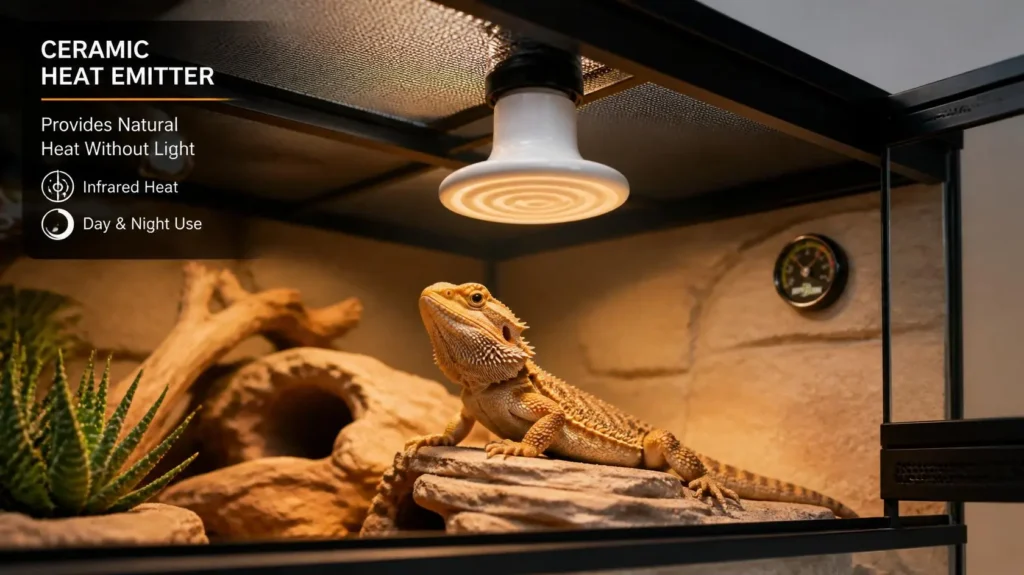
Heat bulbs, UVB tubes, and thermostats all need time to reach a steady state. Run the full lighting and heating setup for 24–48 hours empty before moving your dragon in, and use this window to confirm:
- Basking surface temperature is in the correct range for your dragon’s age
- Cool-side temperature gives a real thermal gradient, not just a slightly cooler version of the hot side
- UVB bulb is positioned at the correct distance for its type and your enclosure height
- Humidity sits in the appropriate range for your climate and setup
This stabilization period matters more in tall enclosures, where heat and UVB intensity change significantly with distance. If your new tank is on the taller side, it’s worth checking your setup against a guide on UVB bulb distance for tall bearded dragon tanks before your dragon goes in, since incorrect UVB exposure is a common hidden stressor that gets blamed on “just the new tank” when it’s actually a lighting placement issue.
If you’re unsure whether your UVB bulb is positioned correctly for any enclosure size, our UVB distance calculator can confirm the right placement based on your bulb type and basking spot height.
Step-by-Step: Introducing Your Dragon to the New Enclosure
Step 1: Confirm Temperatures With a Reliable Thermometer
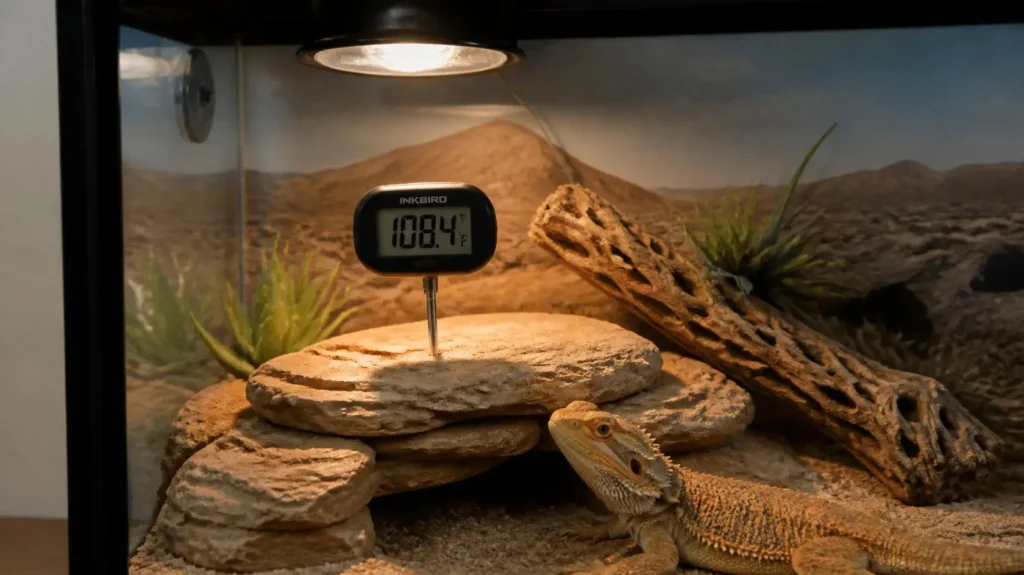
Before moving your dragon, double-check both the basking and cool-zone readings with a digital probe thermometer. Stick-on analog dials read the glass surface, not the air your dragon actually experiences, and can give a false sense of security. If your readings seem inconsistent or don’t match what you’d expect from your bulb wattage, see our guide on what to do when a bearded dragon thermometer is reading wrong before you trust the setup.
Step 2: Add Hides on Both the Warm and Cool Side
A dragon that has nowhere to retreat to stays in a defensive, cautious state longer. Place at least one hide in the basking zone and one in the cool zone so your dragon always has a low-stress option nearby, no matter where it is in the enclosure.
Step 3: Move Your Dragon Calmly, With Minimal Fuss
Lift your dragon slowly from underneath, supporting the full body, and place them directly into the enclosure rather than dropping them in from above — a hand coming from overhead can trigger a natural predator response.
Step 4: Let Them Explore Without Interference
Once your dragon is in, step back. Resist the urge to rearrange things, adjust decor, or reach in again right away. Let your dragon investigate the space at its own pace.
Step 5: Offer Food on a Normal Schedule
Continue your usual feeding times and portions, but don’t be alarmed by reduced interest in the first few days — this is a normal part of settling into unfamiliar territory, not a sign the introduction went wrong.
Step 6: Keep the Lighting Schedule Exactly Consistent
Sudden shifts in day length or “always-on” lighting confuse a dragon’s internal clock and add another layer of unpredictability during an already sensitive period.
Step 7: Observe From a Distance for the First Few Days
Watch basking behavior, movement, and general alertness without opening the enclosure repeatedly. Frequent checking, however well-intentioned, is still activity your dragon has to process as a potential disturbance.
The First Week: What to Do (and Not Do)
| Do | Don’t |
|---|---|
| Keep lighting and feeding on a fixed schedule | Rearrange decor again during week one |
| Offer food normally, even if intake is light | Force-feed or coax with excessive handling |
| Limit handling to brief, calm sessions if needed | Handle daily “to help them adjust” |
| Keep the room quiet and low-traffic | Place the tank somewhere loud or high-traffic |
| Check temperatures once daily | Constantly open the enclosure to check on them |
| Give it at least 5–7 days before judging progress | Panic after day one or two of shy behavior |
Most experienced keepers recommend giving a newly introduced dragon roughly one to two weeks of minimal handling before starting regular interaction, even if the dragon seems calm sooner. Predictability, not attention, is what builds trust fastest during this window.
Reading Stress Signs During the Transition
Some caution is completely normal in the first few days. What you’re watching for is a pattern that doesn’t improve, not a single nervous moment.
Normal, temporary signs:
- Hiding more than usual for the first 2–3 days
- Slightly reduced appetite
- Brief, occasional dark patches on the beard when startled
- Cautious movement or freezing when you walk by
Signs that need attention:
- A consistently dark or black beard that doesn’t fade between disturbances — our guide on why a bearded dragon’s beard is turning black breaks down when this is a normal stress response versus something to monitor more closely
- Repeated glass surfing or clawing at the enclosure walls that continues past the first week
- No basking at all, even after temperatures are confirmed correct
- No interest in food for more than about a week (juveniles) or two weeks (adults)
Catching the difference early lets you adjust the setup — rather than the dragon’s schedule — which is almost always the faster fix.
Enclosure Placement: Where Not to Put a New Tank
Where you physically place the enclosure affects the introduction just as much as what’s inside it. Avoid:
- High-traffic areas with constant walking, loud conversation, or TV noise nearby
- Direct sunlight, which can cause dangerous, unregulated heat spikes inside the tank
- Near speakers, washing machines, or other vibration and noise sources
- Bathrooms, which are a more common placement mistake than most owners realize — swinging humidity from showers, door traffic, and temperature swings can all work against a stable environment. If this is your situation, our guide on keeping a bearded dragon enclosure near a bathroom covers what to watch for and how to manage it if moving the tank isn’t an option
A quiet, consistent, moderately trafficked room — where your dragon can see activity without being startled by it — tends to produce the smoothest adjustment period.
Getting Lighting and Heat Right From Day One
Lighting mistakes are one of the most common reasons a “new enclosure” transition drags on far longer than it should, because incorrect UVB or heat gets mistaken for ordinary settling-in stress.
Bulb type matters for setup difficulty. Mercury vapor bulbs combine heat and UVB into a single fixture and are typically mounted higher, while T5 High Output UVB tubes are linear, require a separate heat source, and are generally mounted closer to the basking area. Getting the type and placement right — rather than assuming any UVB bulb works the same way at any distance — has a direct effect on your dragon’s comfort and calcium metabolism from the very first day. If you’re deciding between setups, our comparison of mercury vapor vs. T5 UVB for bearded dragons breaks down which fits your enclosure better.
Tall enclosures need extra attention. UVB intensity drops off quickly with distance, so a bulb that worked in a shorter tank may be too weak once mounted higher in a taller one. Re-verify distance any time enclosure height changes, using the tall-tank UVB distance guidance as your reference point rather than assuming the old placement still applies.
Pre-Move Checklist
- Enclosure fully set up and running for 24–48 hours before the move
- Basking and cool-zone temperatures confirmed with a digital probe thermometer
- UVB bulb type and distance confirmed correct for enclosure height
- Humidity within appropriate range for your climate
- At least one hide placed on both the warm and cool side
- Enclosure located in a quiet, low-traffic, non-bathroom, non-direct-sunlight spot
- Feeding schedule and food type unchanged from the previous setup
- A plan in place to limit handling for the first several days
Common Mistakes That Extend the Stress Period
- Moving the dragon in before the tank has stabilized. Heat and UVB output can shift meaningfully in the first day of running a new setup.
- Handling daily “to help” during the first week. This usually keeps stress elevated rather than reducing it.
- Rearranging decor again shortly after the move. Every change resets part of the adjustment process.

- Assuming shy behavior always means the introduction went wrong. Cautious behavior for the first few days is expected, not a red flag on its own.
- Placing the enclosure somewhere convenient rather than stable — like near a bathroom, hallway, or speaker — without accounting for humidity and noise swings.
- Not re-checking UVB distance after an enclosure upgrade, especially when moving from a shorter to a taller tank.
Decision Tree: Is Your Dragon Adjusting Normally?
- Is your dragon basking, drinking, and showing some interest in food within the first 3–5 days?
- Yes → This is a normal, healthy transition. Continue the routine and give it another week.
- No → Recheck temperatures, UVB placement, and enclosure location before assuming it’s “just stress.”
- Are stress marks or hiding behavior improving day over day?
- Yes → Your dragon is adjusting on a normal timeline.
- No, it’s staying the same or getting worse → Review the checklist above for a setup issue, and consider consulting a reptile vet if it persists past two weeks.
When to Call a Reptile Vet
Reach out to a reptile-experienced veterinarian if, during or after the introduction to a new enclosure, your dragon shows:
- No food intake for more than about a week (juveniles) or two weeks (adults)
- Lethargy, sunken eyes, or a noticeably thin tail base
- Refusal to drink water alongside refusal to eat
- Persistent dark beard or stress signs that don’t improve despite a correctly set-up enclosure
- Any abnormal breathing, stool, or movement

This article is intended for general education and isn’t a substitute for a hands-on veterinary exam. A vet can rule out illness or impaction that can resemble ordinary transition stress in its early stages.
FAQs
How long does it take a bearded dragon to adjust to a new enclosure?
Most healthy dragons settle within a few days to two weeks, provided temperatures, UVB, and hides are set up correctly and handling is kept minimal during that window.
Should I set up the enclosure before or after bringing my dragon home?
Always before. Run the full lighting and heating setup for 24–48 hours to let temperatures stabilize before your dragon ever goes inside.
Is it okay to handle my bearded dragon right after moving it to a new enclosure?
It’s best to limit handling to brief, calm sessions — or skip it entirely — for the first several days to a week, since frequent handling during this window tends to prolong stress rather than reduce it.
Why does my bearded dragon keep hiding in its new enclosure?
4. Why does my bearded dragon keep hiding in its new enclosure? Hiding for the first few days is a normal caution response. If it continues well past a week alongside no basking or eating, it’s worth rechecking your setup rather than waiting it out.
Does the location of the enclosure in my house actually matter?
Yes. Noise, foot traffic, humidity swings, and direct sunlight all affect how quickly a dragon settles, so a quiet, stable spot supports a smoother transition than a busy or humid one.
Can incorrect UVB placement make the introduction period worse?
Yes. UVB that’s too weak or too intense for the distance it’s mounted at can add ongoing stress that looks identical to normal settling-in behavior but doesn’t resolve on its own.
What’s the difference between mercury vapor and T5 UVB for a new setup?
Mercury vapor bulbs combine heat and UVB in one fixture and mount higher, while T5 High Output tubes are linear, need a separate heat bulb, and typically mount closer to the basking spot — the right choice depends on your enclosure’s height and layout
My thermometer readings seem off since I moved to the new tank — what should I check?
Confirm you’re using a digital probe thermometer rather than a stick-on analog dial, and check placement, since inaccurate readings are a common and fixable cause of temperature-related stress.
Is it normal for a bearded dragon to not eat during the first few days in a new enclosure?
Yes, reduced appetite for the first few days is common and usually resolves once the dragon confirms the new environment is safe and stable.
Can a bathroom be a bad location for a bearded dragon’s enclosure?
Yes, reduced appetite for the first few days is common and usually resolves once the dragon confirms the new environment is safe and stable.
How do I know if my dragon’s stress is normal or a sign of a bigger problem?
Normal stress gradually improves day by day. If hiding, dark beard, or appetite loss stays the same or worsens beyond a week or two, recheck your husbandry setup and consult a reptile vet if there’s no improvement.
Key Takeaways
- Stabilize the enclosure’s temperature, UVB, and humidity for 24–48 hours before introducing your bearded dragon to it.
- Minimize handling for the first several days to a week — predictability, not attention, builds trust fastest.
- Add hides on both the warm and cool side so your dragon always has a low-stress retreat option.
- Enclosure placement matters: avoid high-traffic areas, direct sunlight, and humidity-prone rooms like bathrooms.
- Mild caution and reduced appetite in the first few days are normal; a pattern that doesn’t improve after a week or two is your signal to recheck the setup or call a vet.
Conclusion
Introducing a bearded dragon to a new enclosure without stressing it comes down to sequencing and restraint: get the tank fully stable before the move, place your dragon in calmly, and then give it space and consistency rather than attention. Most of the stress owners see during a tank transition traces back to a setup detail — temperature, UVB distance, or enclosure placement — rather than the move itself. Work through the checklist above before your dragon goes in, keep the first week predictable, and you’ll set the stage for a confident, settled dragon in its new home far faster than trial and error ever would.
This article is for general educational purposes and is not a substitute for personalized veterinary care. If your bearded dragon shows signs of illness or prolonged stress, consult a reptile-experienced veterinarian.

Haseeb Wattoo is the founder and author of Beardie Dragon Pro. He is passionate about bearded dragon care and shares practical, research-based guides on nutrition, habitat setup, health, behavior, and husbandry. His mission is to help reptile owners provide the best care for their pets through accurate, easy-to-understand, and trustworthy information. Haseeb aims to educate both beginners and experienced keepers, promoting responsible pet ownership and healthier, happier bearded dragons.