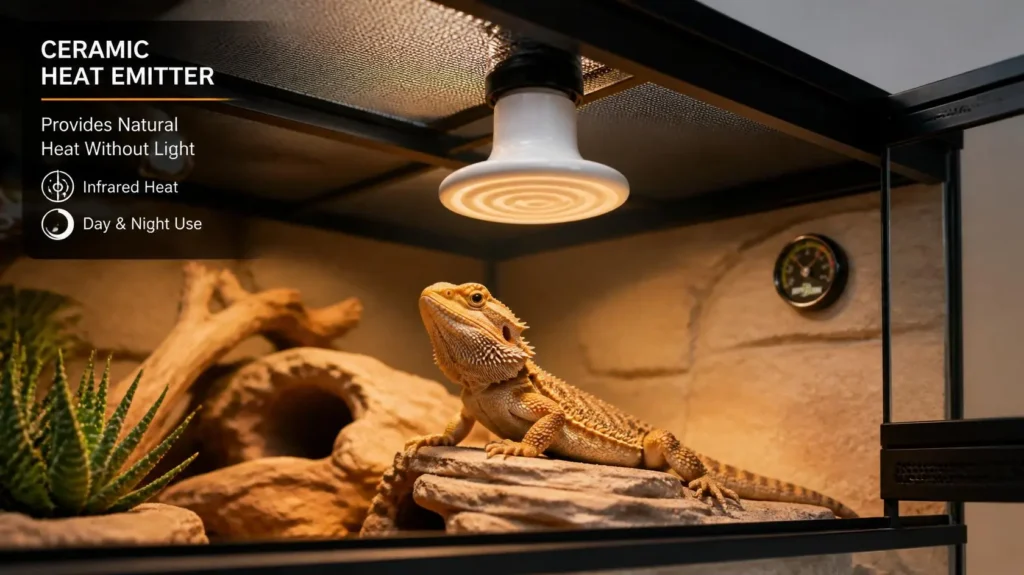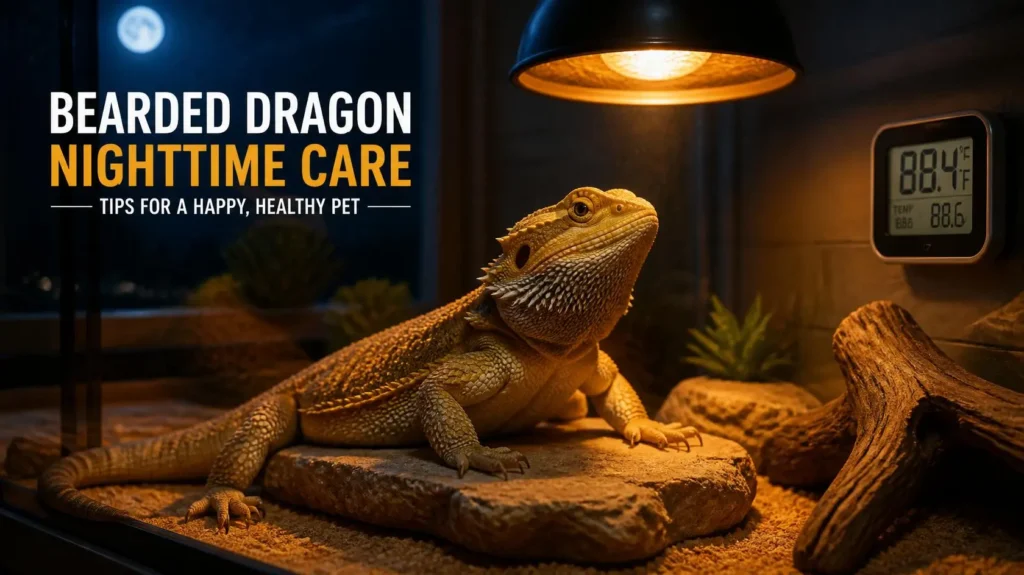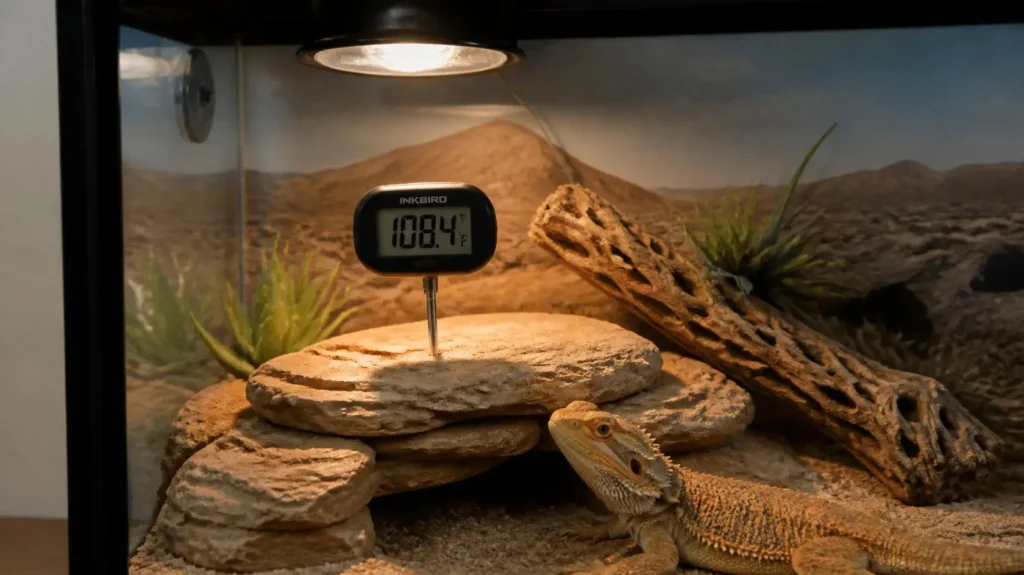

Two bulbs, two very different setups. A mercury vapor bulb (MVB) gives you heat and UVB in one lamp. A T5 HO strip light gives you UVB only, spread evenly across a tube, paired with a separate heat bulb. Both can raise a healthy bearded dragon. But they behave differently enough that picking the wrong one for your enclosure can quietly work against you.
Quick Answer
For most bearded dragon keepers, a T5 HO UVB strip light paired with a separate halogen basking bulb is the better default choice. It gives you independent control over heat and UVB, spreads UVB evenly across a full-body basking area, and is easier to dial in with a UV Index meter.
A mercury vapor bulb (MVB) is the better choice when:
- The enclosure is large (4 feet long or more) and you want one strong, centralized basking spot
- You have a UV meter and are comfortable fine-tuning distance carefully
- You want fewer bulbs to manage in a bioactive or naturalistic build
Neither bulb is “wrong.” The right pick depends on enclosure size, your comfort with monitoring UVI, and whether you want heat and UVB controlled together or separately.
Definitions: MVB and T5 HO, Explained Simply
- Mercury vapor bulb (MVB): A single bulb, usually screwed into a ceramic dome fixture, that produces both UVB and strong basking heat at the same time, in a narrow beam.
- T5 HO (High Output) UVB strip light: A slim fluorescent tube that produces UVB only, spread evenly along its length. It needs a separate basking heat bulb (usually a halogen flood bulb) to complete the setup.
- UV Index (UVI): A standardized measurement of UVB strength at a specific spot, read with a UV Index meter. This is the number that actually matters, not the bulb’s percentage label.
- Ferguson Zone 3: The UV exposure category bearded dragons fall into, based on published research on how much natural UVB open-desert baskers use in the wild.
- Photokeratoconjunctivitis: Eye irritation and inflammation caused by excess UV exposure — the main safety risk when any UVB bulb, MVB included, is mounted too close.
Quick Comparison Table
| Feature | Mercury Vapor Bulb (MVB) | T5 HO UVB Strip Light |
|---|---|---|
| Produces heat and UVB together | Yes, one bulb | No, needs a separate heat bulb |
| Coverage pattern | Narrow, centralized beam | Even spread across the tube’s length |
| Best enclosure size | 4 ft+ long, or 3 ft+ tall | Any size, especially standard 2–4 ft |
| Independent heat/UVB control | No — moving the bulb changes both | Yes — adjust each separately |
| Compatible with a thermostat/dimmer | No | Yes, for the separate heat bulb |
| Typical lifespan | 12+ months in some reports, variable by brand | 6–12 months, output declines gradually |
| Setup difficulty | Moderate to higher — narrow beam needs precise placement | Lower — well-documented distance charts |
| Approx. cost | Higher per bulb, but only one fixture needed | Lower per bulb, but needs tube + separate heat bulb + two fixtures |
| Good for bioactive/naturalistic tank | Yes, fewer fixtures to hide | Yes, but needs more fixture planning |
| Risk if misjudged | Overheating or overexposure in the beam center | Under-dosing if distance/mesh isn’t accounted for |
How Each Bulb Works
A T5 HO tube spreads UVB evenly along its length, which matches how bearded dragons actually bask — with most of the body exposed at once, not just a small patch of skin. Because heat comes from a separate bulb, you can move the heat source to hit the right basking temperature without touching the UVB distance, and vice versa.
A mercury vapor bulb produces UVB and infrared heat from the same arc tube, in a beam that’s strongest at the center and drops off sharply toward the edges. This is efficient — one bulb instead of two — but it also means heat and UVB are locked together. Adjust the bulb’s height to fix the basking temperature, and you’ve also just changed the UVI your dragon receives, for better or worse.
Pros and Cons: Mercury Vapor Bulb
Pros:
- One bulb handles both heat and UVB — fewer fixtures to install and hide
- Can project usable UVB significantly farther than a T5 HO tube, useful for tall or long enclosures
- Popular options (PowerSun, MegaRay) have a long track record among experienced keepers
- Often needs less frequent replacement than fluorescent tubes, though this varies by brand
Cons:
- No independent control — heat and UVB always move together
- Not compatible with a thermostat or dimmer, so temperature control relies entirely on distance and bulb wattage
- The beam is narrow and centralized, which can leave the rest of a large enclosure dim or under-lit

- A small placement error can create dangerously high UVI or excessive heat directly under the beam center
- Generally not recommended for small or short enclosures, where safe minimum distance is hard to achieve
- Quality varies more between cheap and premium brands than with T5 tubes
Pros and Cons: T5 HO UVB Strip Light
Pros:
- Even UVB spread matches how bearded dragons naturally bask, across most of the body at once
- Heat and UVB are controlled separately, so you can use a thermostat on the heat bulb without disturbing UVB output
- Well-documented distance charts from major brands (Arcadia, Zoo Med) make setup more predictable
- Easier to correct a mistake — adjusting one part of the system doesn’t force a change in the other
- Widely regarded by reptile lighting specialists as the current standard for most bearded dragon setups
Cons:
- Requires two separate fixtures (UVB tube plus basking heat bulb), which means more wiring and mounting to plan
- Slightly more visible hardware in the enclosure compared to a single MVB dome
- Fluorescent tube output declines gradually and needs replacement every 6–12 months, even if it still looks bright
- A tube that’s too short for the enclosure leaves the basking zone patchy — length must roughly match enclosure size
UVI, Distance, and Ferguson Zone 3 Targets
Both bulb types are judged by the same standard: bearded dragons need a basking-spot UVI of roughly 3.0–4.0, in line with their Ferguson Zone 3 classification as open-desert baskers. Some sources describe an acceptable working range up to 4.5–6.0 for standard, non-sensitive dragons, but most current keeper guidance converges on the tighter 3.0–4.0 target as the safer, better-tested middle ground.
Typical starting distances (no mesh in the beam path, quality fixture):
| Bulb | Approx. distance for UVI ~3.5–4.0 |
|---|---|
| T5 HO 10–12% | 10–14 in (25–36 cm) |
| T5 HO 14%, good reflector | Up to ~18 in (46 cm) |
| MVB 70W | ~12–18 in (30–46 cm), check manufacturer chart |
| MVB 100W | ~18–24+ in (46–61+ cm), check manufacturer chart |
A mesh top blocks roughly 30–45% of UVB, so distances should be shortened, or output increased, to compensate. These are calibration starting points, not guarantees — bulb age, fixture quality, and reflector design all shift the real number. A Solarmeter 6.5 UV Index meter is the only reliable way to confirm the actual UVI your dragon receives.
Cost and Lifespan Compared
- Upfront cost: An MVB setup usually needs one dome fixture and one bulb. A T5 HO setup needs a linear fixture, a UVB tube, plus a separate heat bulb and fixture — more individual parts, though each part is often cheaper.
- Replacement cost over time: T5 HO tubes are typically replaced every 6–12 months regardless of visible brightness, since UVB output fades well before the light looks dim. MVBs are reported by some keepers to last a year or more, though output should still be checked periodically with a meter rather than assumed.
- Running cost: Both use meaningful wattage for basking heat; actual electricity cost differences are usually minor compared to bulb replacement cost.
Whichever bulb you choose, budget for periodic replacement as a fixed cost of proper husbandry — not an optional upgrade.
Safety Considerations
- Never let a dragon perch closer than the bulb’s minimum safe distance. Both bulb types can cause skin or eye irritation, including photokeratoconjunctivitis, if a basking platform sits too close.
- MVBs concentrate risk in a smaller area. Because the beam is narrow and strong at the center, a basking branch placed slightly too close to an MVB creates a more sudden risk than the same error with a T5 HO tube.
- Glass and mesh both change the picture. Standard glass blocks nearly all UVB, so an MVB or T5 tube must shine into open air or through mesh, never through a glass top. Mesh cuts UVB output but doesn’t eliminate the need for careful distancing.
- Provide an escape route from both heat and light. Whichever bulb you use, your dragon needs a shaded, cooler retreat elsewhere in the enclosure to self-regulate.
- Watch for avoidance behavior. If your dragon stops using the basking spot, treat that as a signal to recheck distance and UVI rather than assuming it’s just a preference.
Veterinary note: This article does not diagnose illness. If your bearded dragon shows squinting, eye swelling, skin irritation, lethargy, or reduced appetite, contact an exotics-experienced reptile veterinarian. These signs can have several causes, and early evaluation matters.
Which One Fits Your Enclosure? (Decision Tree)
- Standard 2–4 ft enclosure, want fine control over heat and UVB separately → T5 HO strip light + separate basking bulb.
- New to bearded dragon keeping, want a well-documented, forgiving setup → T5 HO strip light.
- Large enclosure (4 ft+ long or 3 ft+ tall), want fewer fixtures → Mercury vapor bulb, wattage matched to depth.

- Bioactive or heavily planted build where fixture visibility matters → Either works; MVB uses fewer visible fixtures, T5 HO gives more even plant-friendly light when paired with a daylight bar.
- Enclosure has a mesh top and limited height → T5 HO is usually easier to compensate for mesh loss without overshooting safe UVI.
Common Mistakes With Each Bulb Type
With mercury vapor bulbs:
- Adjusting bulb height to fix temperature without rechecking UVI afterward
- Using an MVB in a small or short enclosure where the safe minimum distance can’t be met
- Assuming a “bright” MVB is still producing adequate UVB without ever measuring it
- Skipping a UV meter entirely and relying on the box’s printed distance chart alone
With T5 HO strip lights:
- Mounting the tube on top of mesh without shortening distance or increasing bulb strength to compensate
- Buying a tube shorter than the enclosure, leaving large sections with no usable UVB
- Placing the UVB tube directly over the heat bulb instead of beside it, creating an uneven basking zone
- Forgetting to replace the tube on schedule because the enclosure still looks well-lit
Step-by-Step: Setting Up Either Option Correctly
- Measure your enclosure’s length and height before buying either bulb type.
- Decide on independent vs. combined control. If you want a thermostat on your heat source, choose T5 HO. If you want one simpler fixture, consider an MVB.
- Match bulb strength or wattage to your basking distance, using the table above as a starting range.
- Account for mesh. Shorten distance or increase output if a screen top sits between the bulb and the basking spot.
- Place the basking platform at the correct distance, not simply “as high as possible.”
- Add a shaded, low-UV retreat elsewhere in the enclosure.
- Measure UVI with a Solarmeter 6.5 at the basking surface and adjust until you land in the 3.0–4.0 range.
- Set a replacement reminder — 6–12 months for T5 HO tubes, and a periodic recheck for MVBs even if they’re marketed as longer-lasting.
Expert Tips
- A reflector meaningfully boosts T5 HO output. A good aluminum reflector fixture can roughly double or triple usable UVB compared to a bare tube, sometimes making a mid-strength tube viable at greater distances.
- Don’t mix outdated advice with either bulb type. Distance charts change as manufacturers test and refine their products — check the specific bulb’s current published data rather than general rules of thumb from older forum threads.

- For MVBs, choose a wide-beam bulb over a narrow one when possible. Reports from experienced keepers suggest wide-beam options create a more even, more forgiving basking zone than bulbs with a tightly focused beam.
- Combine a T5 HO tube with a separate daylight bar for brighter, more naturalistic lighting — MVBs alone can leave the rest of the enclosure comparatively dim.
- Keep a simple lighting log. Note install dates and UVI readings so replacement decisions are based on data, not guesswork.
Frequently Asked Questions
Is a mercury vapor bulb better than a T5 HO tube for bearded dragons?
Neither is universally better. T5 HO gives more control and even coverage for most standard enclosures; MVBs suit large enclosures where a single strong, centralized source is preferred.
Can I use a mercury vapor bulb with a thermostat?
No. Because MVBs combine heat and UVB in one bulb, using a thermostat or dimmer to control temperature would also alter UVB output unpredictably, which isn’t safe.
Which option is cheaper long-term?
It depends on your setup. MVBs need one bulb and fixture but may cost more upfront; T5 HO needs multiple parts but each part is often cheaper. Replacement frequency for either should be based on UVI checks, not price alone.
Do I still need a separate basking bulb if I use a T5 HO UVB tube?
Yes. T5 HO tubes produce UVB, not meaningful heat. You’ll need a separate basking bulb, typically a halogen flood bulb, for proper basking temperatures.
Is a mercury vapor bulb safe for a small enclosure?
Generally, no. MVBs need more distance to reach a safe UVI, which is hard to achieve in a small or short enclosure without risking overexposure.
How far should a mercury vapor bulb be from my bearded dragon?
It depends on wattage and brand, but many 70–100W bulbs are set up in the 12–24 inch range. Always check the manufacturer’s specific distance chart and confirm with a UV meter.
Does mesh affect mercury vapor bulbs the same way it affects T5 HO tubes?
Yes, mesh reduces UVB output from either bulb type. Many keepers choose to mount either bulb type inside the enclosure, below the mesh, when the enclosure design allows it.
Which bulb is easier for a first-time bearded dragon keeper?
T5 HO is generally considered more beginner-friendly because of well-documented distance charts and independent heat control, which leaves less room for a single setup mistake to affect both heat and UVB at once.
Can I switch from an MVB to a T5 HO setup later?
Yes. Many keepers switch bulb types as their enclosure or dragon’s needs change. Just remember you’ll need to add a separate basking heat bulb if you move away from an MVB.
10. How do I know if my bulb, either type, is still producing enough UVB? Visible brightness isn’t a reliable sign. Use a Solarmeter 6.5 UV Index meter to check actual output, and replace fluorescent tubes every 6–12 months regardless of appearance.
11. Are cheaper mercury vapor bulbs risky? Output consistency tends to vary more between budget and premium MVB brands than with T5 tubes. Investing in a well-tested brand and verifying output with a meter reduces this risk.
12. Do both bulb types provide UVA as well as UVB? Many quality bulbs of both types provide some UVA alongside UVB, but coverage and intensity vary by brand and model — check the specific product’s published output data.
Key Takeaways
- T5 HO strip lights give independent heat and UVB control, even coverage, and are the current standard recommendation for most bearded dragon enclosures.
- Mercury vapor bulbs combine heat and UVB in one bulb, which suits large enclosures but removes independent control and concentrates risk in a narrower beam.
- Both bulb types must hit a basking-spot UVI of roughly 3.0–4.0, confirmed with a Solarmeter 6.5, not just a printed distance chart.
- Mesh tops cut UVB output for either bulb type by roughly 30–45% and must be accounted for.
- Neither option is “wrong” — the right choice depends on enclosure size, your comfort monitoring UVI, and whether you want heat and UVB controlled together or separately.
- Replace T5 HO tubes every 6–12 months and periodically recheck MVB output, since UVB output declines before visible brightness does.
Conclusion
The mercury vapor bulb vs. T5 HO decision isn’t about which bulb is objectively stronger — it’s about which setup matches your enclosure and how closely you plan to monitor it. T5 HO strip lights remain the more forgiving, better-documented default for most standard enclosures. Mercury vapor bulbs earn their place in larger setups where one centralized, powerful source makes more practical sense. Whichever you choose, the real safeguard is the same either way: measure the actual UVI at the basking spot, and don’t rely on the box alone.
This article is for general husbandry education and is not a substitute for veterinary care. If you suspect your bearded dragon is unwell, contact an exotics-experienced reptile veterinarian.

Haseeb Wattoo is the founder and author of Beardie Dragon Pro. He is passionate about bearded dragon care and shares practical, research-based guides on nutrition, habitat setup, health, behavior, and husbandry. His mission is to help reptile owners provide the best care for their pets through accurate, easy-to-understand, and trustworthy information. Haseeb aims to educate both beginners and experienced keepers, promoting responsible pet ownership and healthier, happier bearded dragons.