
Quick Answer
Yes — a tank can technically be too big for a juvenile bearded dragon, but size itself isn’t the real danger. The problem is an unmanaged large space: poor temperature gradients, difficulty finding food, and a lack of visual security. A large enclosure is fine — even ideal for avoiding future upgrades — as long as you section it, add dense cover, and manage feeding until your dragon is confident and coordinated enough to use the whole space. Veterinary guidance from Washington State University’s exotics service notes that an oversized enclosure for a small lizard may need to be temporarily reduced to prevent stress.
The Short Answer, Explained
A bearded dragon’s enclosure can absolutely be “too big” for a juvenile in a functional sense — meaning the space isn’t usable or safe for that dragon yet — without being too big in a permanent, structural sense.
Think of it less like a maximum size limit and more like a furniture and management problem. A 4-foot enclosure isn’t dangerous because of its footprint. It becomes a problem when a 4-inch hatchling is dropped into it with a single basking spot, no cover, and open floor space, because the dragon can’t reliably find its heat source, can’t find its food, and has nowhere to feel hidden from what its brain reads as open sky — a classic prey-animal stress response.
The fix isn’t a smaller box forever. The fix is temporary sectioning and deliberate management inside the large enclosure, which most experienced keepers now do specifically to avoid buying multiple tanks as the dragon grows.
Why This Question Confuses So Many Owners
Search results and forums on this topic are genuinely split, and that’s not because people are careless — it’s because two different eras of husbandry advice are colliding.
Older, still widely repeated advice says hatchlings and juveniles should start in a modest 20–40 gallon tank and be upgraded in stages, because a big open space overwhelms them.
Current veterinary and welfare-focused advice (reflected in updated husbandry guidance from exotics-focused veterinary hospitals and reptile welfare organizations) favors starting in the largest enclosure you’ll ever need — commonly 4 ft × 2 ft × 2 ft (roughly 120 gallons) — because bearded dragons are active, cognitively complex lizards that benefit from space, climbing structure, and an actual thermal gradient, which is nearly impossible to achieve in a 20-gallon tank.
Both camps are right about the underlying goal: minimize stress and maximize thermoregulation. They just disagree on the tool. The modern consensus, and the one this article follows, is: big enclosure, small usable footprint at first, expanded as the dragon grows into it.
The Real Risks of an Oversized Juvenile Tank
When people say a tank is “too big,” they’re usually describing one or more of these five specific, fixable problems — not the square footage itself.
1. Diluted or Unreachable Thermal Gradient
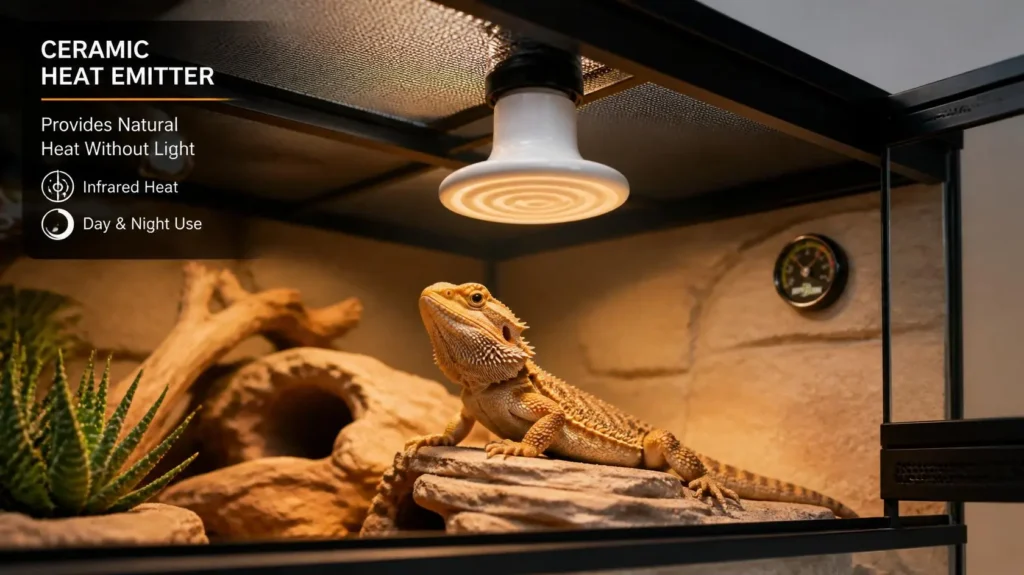
Bearded dragons are ectotherms — they can’t generate their own body heat and depend entirely on moving between a hot basking zone (95–110°F) and a cooler zone (75–85°F) to regulate their temperature. In a large, open, unfurnished tank, a single heat bulb may only warm a small pocket of air, leaving the rest of the enclosure — including the areas a small hatchling instinctively retreats to — too cold for digestion and activity.
2. Difficulty Finding Food
Juveniles rely heavily on live feeder insects (roughly 70–80% of the diet at this life stage, and a young dragon that hasn’t yet developed confident hunting behavior can lose track of fast-moving crickets or roaches across a large, cluttered floor space. This is less about the tank and more about insect containment — which is solvable with feeding bowls or feeding bins rather than free-ranging insects across the whole floor.
3. Perceived Lack of Safety (Open-Sky Stress)
In the wild, a young dragon in open terrain is vulnerable to aerial predators. An enclosure with sparse decor and a wide, exposed floor can trigger the same instinctive vigilance, which shows up as glass surfing, dark stress beard, flattened body posture, or refusal to bask.
4. Overheating in Poorly Zoned Setups
Somewhat counterintuitively, a badly set up large tank can also overheat a small dragon if the whole enclosure heats up without an adequate cool retreat — smaller dragons have less thermal mass and heat up faster than adults.

5. Harder Monitoring
In a heavily planted or decorated large enclosure, it’s simply harder for a new owner to visually confirm eating, basking, and normal behavior in a small, fast-moving juvenile.
None of these five problems require a smaller tank. They require better management of the tank you have.
What the Evidence Actually Supports
To keep this article evidence-based rather than opinion-based, here’s what’s actually documented versus what’s common but unverified keeper folklore.
Well-supported:
- Ectotherms require an accurate thermal gradient to digest food and regulate metabolism; this is basic reptile physiology, not a stylistic preference.
- Feeder insects roaming loose can go unnoticed and bite a resting dragon, and uneaten insects should be removed — a widely repeated point across veterinary and breeder care sheets alike.
- Washington State University’s veterinary exotics guidance explicitly states that an oversized enclosure for a smaller lizard may need to be made temporarily smaller to prevent stress, and recommends a minimum enclosure length of roughly three times the dragon’s total body length.
- Rapid early growth (a hatchling can go from about 3–4 inches to 9+ inches within a couple of months) means any “right-sized” small tank is quickly outgrown, which is why many current guides recommend starting big and sectioning down rather than buying two or three tanks in the first year.
Common but not scientifically settled:
- The claim that a large tank directly causes malnutrition or failure to thrive. This isn’t documented in veterinary literature as a direct causal link — what’s documented is the secondary effect (insects going uneaten because the dragon can’t locate them), which is a husbandry management issue, not an enclosure-size issue.
- Specific gallon-for-age formulas circulating online vary widely between sources and aren’t standardized by any veterinary or herpetological body — treat them as general starting guidance, not hard rules.
Never invent certainty where none exists: if you see a care sheet stating an exact “stress threshold” in square inches, treat it as a rule of thumb from an experienced keeper, not a peer-reviewed finding.
Signs Your Juvenile’s Tank Is Genuinely Too Big Right Now
Not every large enclosure is a problem — but watch for this cluster of behaviors, especially in the first few weeks after a move or setup change:
- Persistent glass surfing (repeated clawing/pacing along the glass) that doesn’t settle after 1–2 weeks
- Dark, blotchy “stress beard” or stress marks that appear even when the dragon isn’t being handled
- Refusing to bask or basking only briefly before retreating

- Visibly missing or ignoring feeder insects at multiple consecutive feedings
- Weight loss or a growth rate that has noticeably slowed
- Hiding for the majority of daylight hours instead of exploring
One or two of these on a single day is normal adjustment. A pattern across a week or more, especially combined with reduced eating, is your signal to intervene — and a reason to loop in a reptile-experienced vet if it doesn’t resolve.
How to Safely Raise a Juvenile in a Large Enclosure
This is the core information most competing articles skip. Here’s a practical, step-by-step approach for keeping a young dragon in a large (75–120+ gallon) enclosure from day one, without the downsides.
Step 1: Section the Enclosure Temporarily
Use non-toxic, reptile-safe dividers, foam board, or opaque panels to reduce the usable space to roughly the size of a 20–40 gallon footprint for the first several weeks. Expand the section every couple of weeks as the dragon grows and gains confidence.
Step 2: Build a Complete Thermal Gradient Within the Reduced Zone
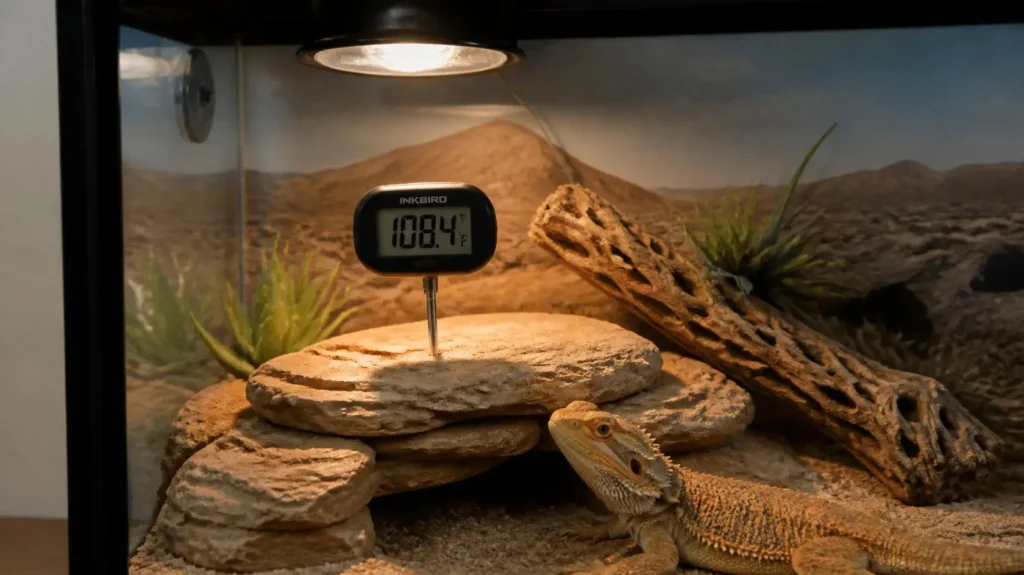
Even in a partitioned space, confirm both a basking zone (95–110°F for hatchlings/juveniles) and a cool retreat (75–85°F) with a digital probe thermometer — not a stick-on analog dial, which reads the glass, not the air.
Step 3: Add Dense, Low Cover — Not Just Height
Young dragons feel safer with horizontal hiding options (cork bark tunnels, low branches, flat rock overhangs) at multiple points across the zone, not just one hide on each end. This directly reduces open-sky stress.
Step 4: Contain Feeder Insects
Use a shallow feeding dish or a slick-sided feeding tub instead of releasing crickets or roaches to roam the whole floor. This solves the “can’t find food” problem regardless of enclosure size and also prevents insects from biting a sleeping dragon.
Step 5: Use a Solid, Easy-to-Clean Substrate Early On
Paper towel, newspaper, slate tile, or reptile carpet are commonly recommended for hatchlings and juveniles because young dragons explore with their mouths, and loose substrate raises impaction risk before hunting coordination is fully developed.
Step 6: Watch, Don’t Guess
Track basking behavior, appetite, and stress marks for the first 1–2 weeks in any new or resized setup. Adjust gradually — expanding usable space is easy; walking back a stressed dragon takes longer.
Step 7: Expand as They Grow
As your dragon hits 9–12+ inches and is confidently hunting, basking, and exploring, gradually remove dividers until they have full access to the entire enclosure — no second tank purchase required.
Enclosure Size Chart by Age and Length
| Life Stage | Approximate Age | Approximate Length | Minimum Enclosure (Immediately Usable Space) | Ideal Long-Term Enclosure |
|---|---|---|---|---|
| Hatchling | 0–2 months | 3–9 inches | 20-gallon equivalent, sectioned | 40-gallon or larger, sectioned down |
| Juvenile | 3–12 months | 9–16 inches | 40-gallon equivalent | 75–120 gallon (4 ft × 2 ft × 2 ft) |
| Sub-adult | 12–18 months | 16–20 inches | 75-gallon | 120 gallon |
| Adult | 18+ months | 18–24 inches | 100–120 gallon | 120+ gallon, PVC/wood preferred |
Figures are general husbandry guidance compiled from multiple current care sources, not a single universal standard. Always prioritize thermal gradient quality and behavior over exact gallon counts.
Small Tank vs. Large (Sectioned) Tank: Pros and Cons
| Factor | Small Tank First, Upgrade Later | Large Tank From Day One (Sectioned) |
|---|---|---|
| Upfront cost | Lower now, higher over time (multiple purchases) | Higher now, lower over time (one purchase) |
| Risk of outgrowing | High — often within a few months | None |
| Setup complexity | Simple | Requires temporary dividers/management |
| Thermal gradient control | Easier by default | Requires deliberate zoning |
| Long-term welfare (space, enrichment) | Requires future upgrade to reach ideal | Naturally reaches ideal size over time |
| Risk of hatchling stress if mismanaged | Lower | Higher if not sectioned properly |
Decision Tree: Which Setup Is Right for Your Dragon?
- Do you already own or want a large enclosure (75+ gallons or 4 ft)?
- Yes → Section it down to a manageable footprint now; expand gradually as your dragon grows. This avoids future tank purchases entirely.
- No, you have a 20–40 gallon tank → That’s fine for a hatchling/young juvenile, but plan your upgrade before your dragon outgrows it — growth can be rapid in the first 4–6 months.
- Is your juvenile showing stress signs (glass surfing, refusing food, dark beard) right now?
- Yes → Reduce usable space with dividers, add more low cover, confirm your thermal gradient with a digital probe thermometer, and contain feeder insects in a bowl.
- No → Continue current setup, but keep monitoring during any changes (new decor, new room, new lighting).
Common Mistakes Owners Make With Large Tanks
- Adding one heat bulb and calling it done. A large enclosure needs a genuine gradient — a single basking bulb over an otherwise unmanaged floor plan leaves most of the space unusable.
- Free-ranging feeder insects across the whole floor. This is the single most common cause of “my juvenile won’t eat in its big tank.”
- Skipping ground-level hides. Height doesn’t equal security for a young dragon; low, tunnel-style cover matters more early on.
- Using loose substrate too early. Sand or loose particulate substrate raises impaction risk before a juvenile has reliable hunting accuracy.<sup>[4]</sup>
- Placing the tank in a high-traffic, loud, or brightly reflective area, which compounds stress independent of enclosure size.
- Panic-downsizing permanently instead of temporarily sectioning — this just delays the inevitable upgrade and adds cost.
Expert Tips for a Stress-Free Transition
- Move new decor or dividers gradually rather than all at once — dragons acclimate faster to incremental change.
- Track weight and length monthly. A juvenile that’s gaining size and weight on schedule is rarely being harmed by tank dimensions, even a large one.

- If stress marks or glass surfing appear only after a specific change (new bulb, moved furniture, new room), that change — not the tank’s overall size — is almost always the actual trigger.
- Reflective glass can itself be a stress source separate from size; a background on three sides reduces perceived exposure regardless of tank dimensions.
When to Call a Reptile Vet
Contact a reptile-experienced veterinarian promptly if you notice any of the following, since these can indicate husbandry-related illness rather than simple adjustment stress:
- Refusal to eat for more than 2–3 days in a juvenile
- Visible weight loss or a sunken tail base
- Lethargy that doesn’t improve with correct basking temperatures
- Swollen or soft limbs/jaw (possible signs of metabolic bone disease)
- Diarrhea, unusual stool, or signs of straining
- Any suspected substrate impaction (loss of appetite plus firm abdominal swelling)
This article does not diagnose conditions or recommend treatment. If your dragon shows any of the above, husbandry should be reviewed by a professional alongside a veterinary exam, as WSU’s exotics service notes that many common bearded dragon health problems trace back to husbandry rather than disease alone.
FAQs
Is a 40-gallon tank too big for a baby bearded dragon?
No. A 40-gallon tank is a commonly recommended size for hatchlings and juveniles and is well within normal range, especially if you add hides and contain feeder insects at feeding time.
Can a large tank stunt a bearded dragon’s growth?
There’s no direct evidence that enclosure size alone stunts growth. What can slow growth is a large unmanaged tank where a juvenile consistently misses meals because it can’t locate feeder insects — a fixable feeding-management issue.
How do I know if my dragon is stressed by its tank size versus something else?
Look for a pattern: persistent glass surfing, dark stress beard, reduced appetite, and reluctance to bask that appears together and lasts more than a week or two, especially right after a setup change.
Should I buy a 20-gallon tank for a hatchling and upgrade later, or start big?
Both approaches work. Starting big and sectioning the enclosure avoids buying multiple tanks as your dragon grows quickly in its first year, but it requires more deliberate zoning and monitoring upfront.
What size enclosure do I need for an adult bearded dragon eventually?
Most current guidance recommends a minimum of 4 ft × 2 ft × 2 ft (roughly 100–120 gallons) for a single adult, with larger being generally preferred.
Can I put a hatchling directly into a 120-gallon enclosure?
Yes, if you section it down to a smaller usable footprint at first, provide dense low cover, confirm an accurate thermal gradient, and contain feeder insects — then expand the space gradually as the dragon grows.
Why does my juvenile keep glass surfing even though the tank seems fine?
Common triggers include reflections, a nearby ceiling fan or foot traffic, an inaccurate or incomplete thermal gradient, or not enough low, enclosed hiding spots — not necessarily overall tank size.
Is it bad to use loose sand substrate for a juvenile in a large tank?
Most current husbandry guidance recommends solid substrate (tile, paper towel, reptile carpet) for hatchlings and young juveniles because of impaction risk, switching to loose substrate only once hunting accuracy is well established.
Do juvenile bearded dragons need a background on the tank?
A background or covering on three sides can reduce stress from reflections and the sense of exposure, which is independent of the enclosure’s overall size.
How quickly do juveniles outgrow a small enclosure?
Growth is rapid in the first several months — dragons can go from a few inches to 9+ inches within roughly two months — which is a major reason many keepers now start with a larger enclosure from the beginning.
What’s the minimum enclosure length recommended by veterinary sources?
Washington State University’s veterinary exotics guidance recommends an enclosure length of at least three times the lizard’s total body length, adjusting enclosure usability (not necessarily buying a smaller tank) for younger animals.
Key Takeaways
- A tank can be functionally too big for a juvenile bearded dragon, but the risk comes from poor thermal zoning, loose feeder insects, and lack of cover — not the square footage itself.
- Veterinary guidance supports temporarily reducing the usable space of an oversized enclosure for a young or small dragon rather than assuming bigger is automatically worse.

- Starting with a large enclosure and sectioning it down is a valid, increasingly common strategy that avoids multiple tank purchases as your dragon grows.
- Watch for a pattern of stress signs (glass surfing, dark beard, missed meals, hiding) rather than reacting to a single off day.
- Persistent appetite loss, lethargy, or physical changes warrant a reptile-experienced veterinarian, not just a husbandry tweak.
Conclusion
The honest answer is more nuanced than a simple yes or no: an enclosure can be too big for a juvenile bearded dragon to use safely without help, but it’s rarely too big to own. The dimensions of the glass or PVC box aren’t the risk — an unmanaged thermal gradient, loose feeder insects a young dragon can’t track, and a lack of secure hiding spots are. Section a large enclosure down, build in a real gradient, contain feeding, and expand the space as your dragon grows, and you’ll get the best of both worlds: a stress-free juvenile now and a fully-grown-into forever home later.
This article is for general educational purposes and is not a substitute for personalized veterinary care. If your bearded dragon shows signs of illness or persistent stress, consult a reptile-experienced veterinarian.

Haseeb Wattoo is the founder and author of Beardie Dragon Pro. He is passionate about bearded dragon care and shares practical, research-based guides on nutrition, habitat setup, health, behavior, and husbandry. His mission is to help reptile owners provide the best care for their pets through accurate, easy-to-understand, and trustworthy information. Haseeb aims to educate both beginners and experienced keepers, promoting responsible pet ownership and healthier, happier bearded dragons.