
Quick Answer
If you live in a dry place but your bearded dragon’s tank still feels too humid, the moisture is coming from inside the tank, not from the air outside your home. The usual causes are: too much water in the dish, damp substrate (the material on the tank floor), live plants, too much misting, or poor airflow. Bearded dragons need humidity around 30–40%. Fix the airflow first. Then fix the water and substrate. Most tanks return to normal within a few days.
1. Why This Happens Even in a Dry Climate
This mixes up a lot of new owners. You live somewhere dry, maybe Arizona, Nevada, or another hot region. But your dragon’s tank still shows high humidity. It feels like it shouldn’t be possible.
Here’s the simple reason: a tank is its own little world. It doesn’t breathe the same air as your house. Once you add water, substrate, and a heat lamp, the room outside barely matters. The tank makes its own humidity, and glass or plastic walls trap it inside.
The moisture almost always comes from one of these:
- The water dish
- Wet substrate
- Live plants
- Too much misting (spraying water)
- A humidifier running in the same room
- Poor airflow, so moisture can’t escape
Why this matters: Bearded dragons come from the dry desert regions of central Australia. Their bodies are built for dry air. A tank that stays too humid, for too long, works against their natural biology, even if you did everything else right.
2. What Humidity Level Is Right for a Bearded Dragon
| Age | Best Humidity Range |
| Baby (0–3 months) | 30–40% |
| Young dragon (3–12 months) | 30–40% |
| Adult | 20–35% |
A short jump in humidity right after misting or cleaning is normal and not a problem. What matters is whether humidity stays high for hours or days at a time.
Expert tip: Check your tank’s humidity at the same time each day for a week before making any changes. This gives you a real baseline instead of reacting to one unusual reading.
3. Signs Your Tank Is Too Humid
Watch for these warning signs:
- Water drops (condensation) on the glass that don’t go away during the day
- A damp or moldy smell coming from the tank
- Substrate that never fully dries out between cleanings
- Mold on wood, decorations, or substrate
- Your dragon acting tired or eating less than usual
- Dark or discolored skin, especially on the belly or toes
- Wheezing, clicking sounds, or breathing with an open mouth
- Shed skin that looks soft and won’t come off easily
A little morning condensation on its own isn’t automatically a red flag. It’s the combination of several of these signs, especially lasting all day, that points to a real problem.
4. Step 1: Check If Your Hygrometer Is Working Right
Before changing anything, make sure your humidity gauge (called a hygrometer) is actually telling the truth. Cheap dial hygrometers that come bundled with starter kits are often wrong, sometimes by 15–20%.
Simple accuracy test:
- Put a little table salt in a bottle cap. Add a few drops of water so it’s damp, not soggy.
- Place the cap and your hygrometer together inside a sealed plastic bag.
- Wait 8–12 hours.
- A correct hygrometer should read close to 75%.
- If it’s way off, don’t trust it. Replace it with a digital hygrometer.

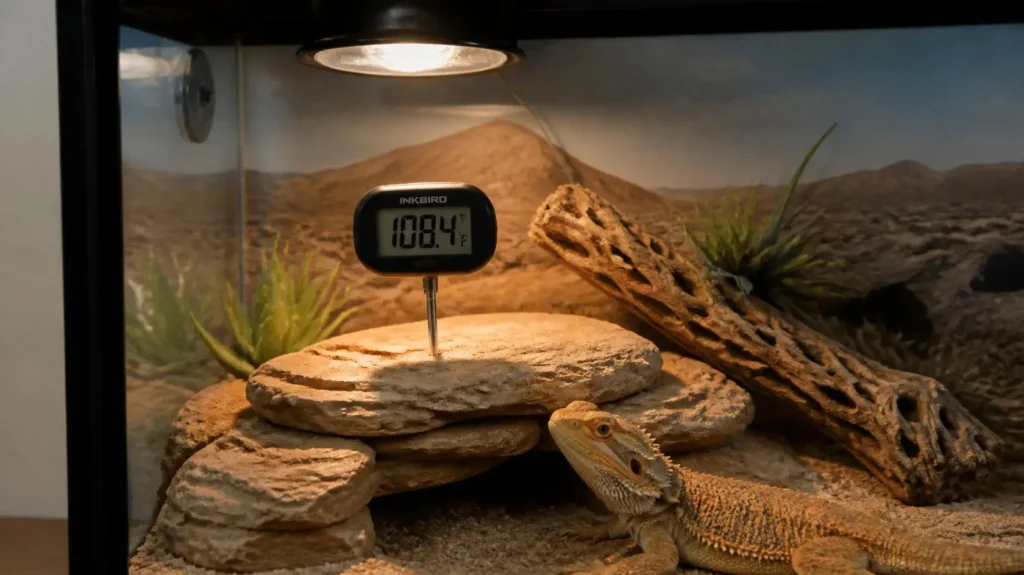
Placement tip: Put the hygrometer near the tank floor, where your dragon actually spends its time, not up near the screen top, where the air is naturally drier.
5. Step 2: Find Where the Moisture Is Coming From
Go through this list one item at a time. Changing everything at once means you’ll never know what actually fixed the problem.
- Water dish — Is it bigger or deeper than it needs to be?
- Substrate — Is it a type that holds water, like soil, coconut fiber, or moss?
- Live plants — Real plants release moisture into the air constantly, not just when watered.
- Misting — Are you spraying water daily out of habit, following advice meant for a different species?
- The room — Is there a humidifier, diffuser, or open bathroom nearby?
- Recent cleaning — Did you wipe the tank with a wet cloth and close the lid right away?
6. Step 3: Fix the Airflow
This is usually the single biggest fix, and the one people skip.
- Open up more of the screen top. Avoid covering it too much, even to hold in heat.
- Use side vents if your tank has them.
- Don’t crowd the tank with decor that blocks air movement across the substrate.
- Keep the tank away from bathrooms, kitchens, and humidifiers.
- A small fan pointed near, not directly at, the tank can help move air through the room.
7. Step 4: Change the Water, Substrate, and Misting
| Change This | From | To |
| Water dish | Big, deep bowl | Small, shallow dish |
| Misting | Every day | Only when needed for shedding |
| Substrate | Soil, coconut fiber, moss | Tile, slate, or paper liner |
| Plants | Tropical, moisture-loving plants | Dry-climate plants or artificial plants |
| Cleaning | Wipe wet, then close the lid right away | Wipe, then leave the top open 15–20 minutes to dry before closing |
Note for bioactive setups: If you run a bioactive tank with a cleanup crew (isopods or springtails), you likely can’t remove all moisture-holding elements. In that case, lean harder on airflow and a well-drained substrate layer instead.
8. Step 5: Watch the Heat and Condensation
Heat and humidity work as a team. Warm air holds more moisture than cool air. When that warm, moist air touches the cooler glass, water drops form. That’s why condensation often shows up in the evening, after the lights and heat turn off.
- Make sure your heat lamp isn’t too strong for the size of your tank.
- Check that the cool side of the tank isn’t dramatically colder than the warm side.
- If you run heat overnight, make sure it isn’t creating a damp, stuck-air pocket near the floor.
9. Which Tank Type Is Best?
| Tank Type | Holds Humidity | Airflow | Best For |
| Glass tank with screen top | Medium–High | Only from the top | Budget setups, but needs careful venting |
| PVC enclosure | High | Depends on vents | Keepers who want full climate control |
| Wood with screen front | Low–Medium | Usually good | Naturally drier setups |
| All-screen enclosure | Very Low | Excellent | Only suitable in already-humid climates |
10. Checklist to Stop It From Happening Again
- [ ] Digital hygrometer placed at tank floor level
- [ ] Hygrometer tested for accuracy
- [ ] Water dish is small and shallow
- [ ] Substrate doesn’t hold much moisture
- [ ] No tropical live plants, unless airflow is very strong
- [ ] Misting only when needed, not on a daily habit
- [ ] Screen top mostly open
- [ ] Tank is away from bathrooms and humidifiers
- [ ] No condensation lingering on the glass by midday
11. Common Mistakes
- Copying care advice made for other reptiles. Advice for tropical pets like chameleons often calls for daily misting. That’s too much moisture for a bearded dragon.
- Covering too much of the screen top to hold in heat, which traps humidity along with it.
- Using a water dish that’s bigger than necessary.
- Assuming a dry climate outside guarantees a dry tank inside. It doesn’t work that way, as explained in Section 1.
- Never checking if the hygrometer is accurate, and chasing a problem based on a false reading.
- Changing too many things at once, so you never learn what actually solved it.
12. When to Call a Vet
Too much humidity for too long is linked to two health problems in bearded dragons:
- Respiratory infection — signs include open-mouth breathing, clicking or wheezing sounds, mucus around the nose, tiredness, or a drop in appetite.
- Scale rot — dark spots, blisters, or a bad smell on the belly, toes, or tail, caused by skin resting against wet substrate for too long.
This article is for general information only. It’s not a diagnosis, and it doesn’t replace an exam. If you notice any of these signs, contact a veterinarian experienced with reptiles as soon as you can. Early treatment makes a real difference for both conditions.
13. Quick Decision Guide
Is your hygrometer digital and tested for accuracy?
├── No → Test it or replace it first.
└── Yes → Is humidity staying above 40–50% for hours at a time?
├── No, just short spikes after misting → That’s normal.
└── Yes → Is the screen top mostly covered?
├── Yes → Open it up more. Recheck in 24 hours.
└── No → Is there a big water dish, live plants, or wet substrate?
├── Yes → Fix those first.
└── No → Check the room for humidifiers or nearby humid spaces.
14. FAQs
1. Can too much humidity make my bearded dragon sick?
Yes. Ongoing high humidity is linked to respiratory infections and scale rot. See a vet if you notice symptoms.
2. Why is my tank humid if my house is dry?
Because the tank makes its own humidity from water, substrate, plants, and heat. Room air matters far less than most people assume.
3. What’s the right humidity for a bearded dragon?
Around 30–40% for young dragons, and 20–35% for adults.
4. Do bearded dragons need daily misting?
No. Mist only occasionally, mainly to help with shedding.
5. What substrate is best for low humidity?
Tile, slate, or paper liners. If you prefer loose substrate, choose one made for desert species, not tropical ones.
6. Should I remove the water dish to lower humidity?
No. Your dragon needs constant access to water. Just switch to a smaller, shallower dish.
7. Is condensation on the glass always a bad sign?
Not always. A little in the morning is normal. Condensation that lasts all day, especially with a bad smell, points to a real problem.
8. Can live plants cause high humidity?
Yes. Real plants release moisture into the air constantly, even without direct watering.
9. How do I know if my hygrometer is wrong?
Run the salt test described in Step 1. It takes less than a day and tells you exactly how far off your reading is.
10. Will a bigger tank fix the humidity problem?
Not by itself. A larger tank can dilute moisture slightly, but you still need to fix the water, substrate, and airflow.
11. How long does it take to fix a humid tank?
Most tanks return to a normal range within 2–5 days once airflow, water, and substrate are corrected. If humidity stays high after a week of changes, recheck your hygrometer and look for a source you may have missed, such as a nearby humidifier.
15. Key Takeaways
- Tank humidity comes from inside the tank, not from the weather outside your home.
- Aim for 30–40% humidity for young dragons, 20–35% for adults.
- Fix airflow first. Open up the screen top before changing anything else.
- Use a smaller water dish, drier substrate, and cut back on misting.
- Always confirm your hygrometer is accurate before troubleshooting further.
- See a vet promptly if your dragon shows signs of illness.
Conclusion
A humid tank in a dry climate isn’t a strange contradiction. It simply means the tank is holding onto moisture that it created itself. Start with airflow, since that’s the fix most owners overlook. Then work through the water dish, substrate, and misting habits. Confirm your hygrometer is giving you real numbers before you assume you’re done. Most tanks settle back into a healthy range within a few days. If your dragon shows any signs of illness along the way, don’t wait it out. Reach out to a reptile-experienced veterinarian.

Haseeb Wattoo is the founder and author of Beardie Dragon Pro. He is passionate about bearded dragon care and shares practical, research-based guides on nutrition, habitat setup, health, behavior, and husbandry. His mission is to help reptile owners provide the best care for their pets through accurate, easy-to-understand, and trustworthy information. Haseeb aims to educate both beginners and experienced keepers, promoting responsible pet ownership and healthier, happier bearded dragons.